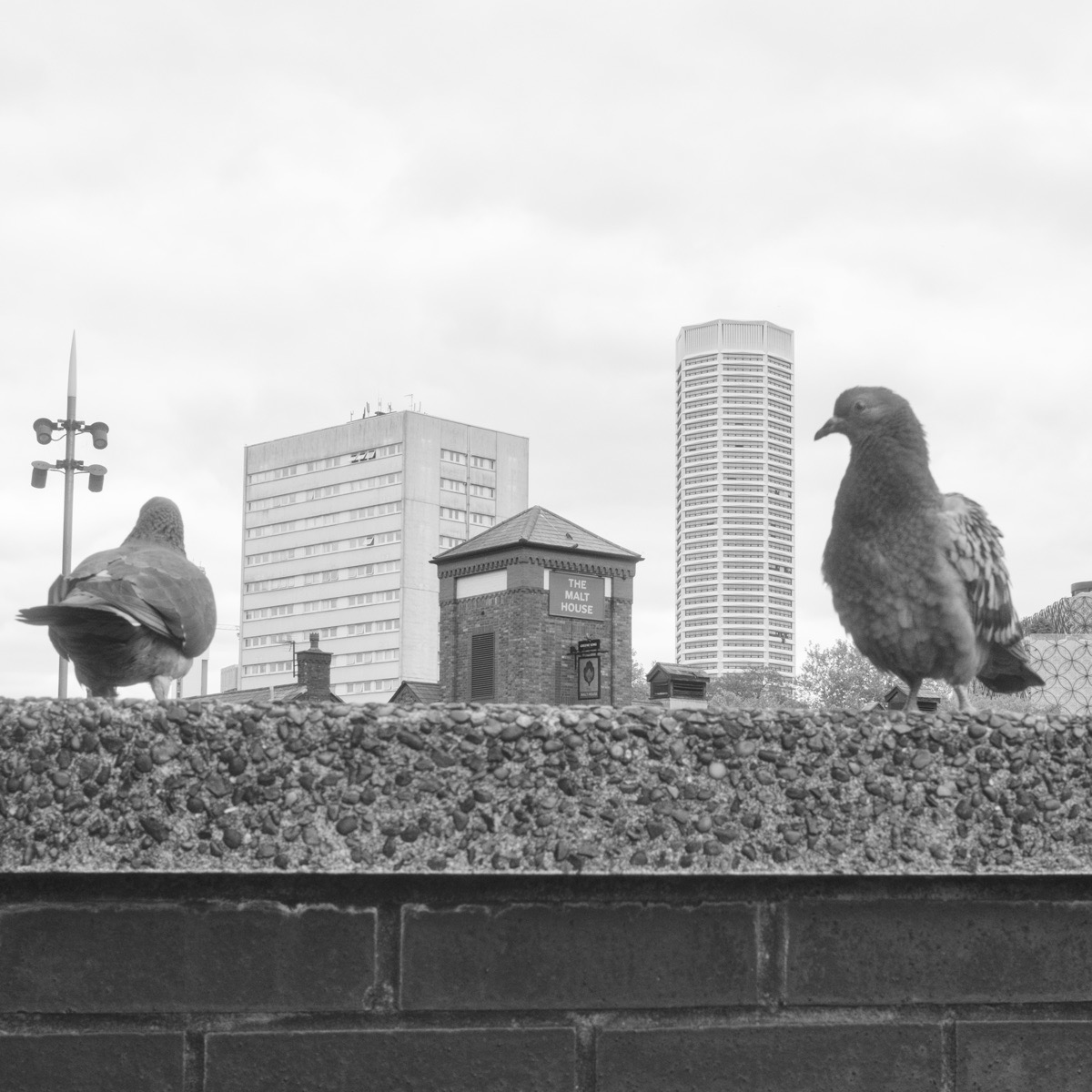
I took a walk from Snow Hill train station up towards Edgbaston village where I had a meeting. This is a collection of 10 images in black and white from my walk. All taken with my Fujifilm x100vi and converted to monochrome.
Brutilistic designCube 20Tagged windowsBusy towpathBnW not blueFive ways HouseForgotten entranceBroken WindowsEdgbaston Village
Enjoyed this, then read some more about Birmingham in Black and White.
Halifax, Nova Scotia is a city alive with creativity. During my visit for an ultrasonics symposium, I discovered just how vibrant and artistic the city is especially when it comes to street art. Between conference sessions, I made time to explore. Dr Andrew Mathieson is on the board of UIA and also lives in Dartmouth. Andrew kindly shared recommendations of the city with the conference delegates. When I mentioned my love for street art, he immediately suggested I visit Quinpool Road. This is a student-friendly area just behind the Halifax Citadel.
On the last day of the conference, the sessions wrapped up early, giving me a free afternoon. The sun was shining as I set off on foot, making my way through the lively Dalhousie University campus. Students filled the walkways and the place was buzzing with energy.
Quinpool Road and a tantalising glimpse of a mural.
Arriving at the head of Quinpool Road, I was disappointed. There were one or two artistic pieces here and there, but not the mural-rich environment I had been told about. I passed by Dilly Dally Coffee Shop, still searching. Behind the cafe at the intersection of Quinpool and Vernon, I found beautifully crafted lettering by mural artist Kristen De Palma (@kdpletters | kdpletters.com). Her work stands out in an otherwise hidden spot.
Colourful Typography by by mural artist Kristen De Palma.
I was still looking for more murals and asked a local resident for guidance. They gave me a valuable tip: “Look around — check the alleyways and look behind buildings.”
The first large mural I encountered was on the Recreation Nova Scotia building. This was a striking blue mural of local fishing boats by Dom Laporte. From that moment on I began to notice murals everywhere.
A blue harbour scene mural by Dom Laporte
Across the street stood the old cinema building which is now home to a climbing gym and a brewery. On the wall there was a quote from The Wizard of Oz, commemorating one of the final films screened there in 2017. This nostalgic piece was painted by @alexjfowkes.
Tribute to the Wizard of Oz.
One of my personal favourites was tucked away in a car park just off the main road. Titled Cattails and Pansies, the mural by Montreal-based artist Bosny (@bosny.jpg) pulled me into its intricate details. His artistic approach invites viewers to slow down and look more closely at the style of the artwork.
Cattails and Pansies, by the artist Bosny
As I walked towards the more residential end of Quinpool Road, I came across a dominant mural on the wall of Pro Skates across from Oddfellows Barbershop. Created by Jeks One (@jeks_nc) the mural honours the late John Dunsworth, best known for playing Jim Lahey on the cult Canadian series Trailer Park Boys, which is set in the fictional Sunnyvale Trailer Park in nearby Dartmouth. Although I am not familiar with the show, I appreciated the care and character captured in this tribute.
Trailer Park Boys
On the return walk, I found more murals, including a wonderfully detailed wall painting outside Busan Korean BBQ. Created by local artist Dan Burt, it is a vibrant homage to Quinpool Road’s history. The artwork is full of local references, stories, and even a bus seemingly rising from the pavement.
Seen outside on the wall of the Busan Korean BBQA street scene with a real bus!
Other pieces had no listed artist but were just as memorable. Even the electrical power boxes had been transformed and were painted with bright, creative designs.
@deliveravalon@nessyrt@mollymargaretart
.
Other examples of street art along Quinpool Road.
Love EvolvesColours on the old Cinema.Dog FoodStrike out
. Quinpool Road is a lively area with restaurants and shops. The people who live and work there seem to accept that their everyday lives are part of the artwork, making it an ideal place for street photography. This student road is just one example of street murals in Halifax .
More examples of street art around Halifax – seen outside Pier 22, where the cruise ships arrive.
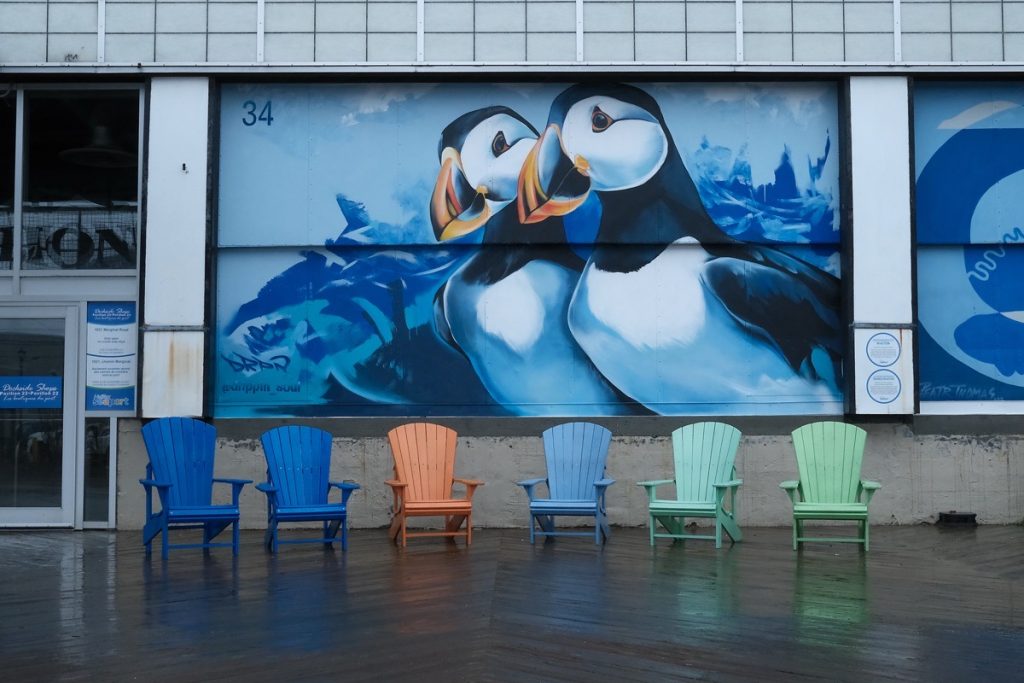
Reflections in the rainPuffins and Deck ChairsLighthouse on the pier.
Halifax harbour waterfront.
Surfing the WaveAn Eagle mural by WarriorSunrise on the pier
Street Murals on Burlington Street walking Northwards
Colourful wallsPiano playersRainbow shaking handsMural depicting the people of Halifax
From large-scale murals to hidden gems, Halifax is a city full of colour, character, and creativity. If you are an enthusiast for street art and love to photograph such murals then Halifax offers many opportunities. Quinpool Road stands out but there are many other places where colourful art greets you. I did enjoy walking along the streets of Halifax looking out for examples of murals on buildings.
Much of the background information I gathered came from the Discover Halifax website which is an excellent resource for anyone keen to explore the city’s artistic side. I have not been able to list all the artists and for this I apologise. Please let me know and I will add your name to the list.
Further blog reading
I do enjoy taking pictures of street art along with the street photography that goes along with it. Two of my blogs will lead you into more UK based street art. Please feel free to browse through the articles.
There is something hauntingly beautiful about the Atlantic coast of Nova Scotia. The dramatic skies, the churning sea, and the wind-whipped coast all make for a landscape that is as raw as it is inspiring. I recently had the opportunity to explore this iconic stretch of Canada’s coastline during a weekend trip to Halifax—and what a memorable journey it turned out to be.
Fishing boat with lobster cases.
I was in Nova Scotia for the UIA Symposium, hosted at the Westin Hotel in Halifax. A colleague, Lisa, and I had arrived a few days early, hoping to explore the local sights—specifically, Peggy’s Cove and the historic town of Lunenburg. Both are about an hour’s drive from the city. Unfortunately, my plans to hire a car fell through when I realised that I had left my credit card at home. That setback turned Saturday into a relaxed day of exploring Halifax on foot, which was no bad thing. However, I still held out hope for a coastal adventure.
The rugged and wild Atlantic coast at Peggy’s Cove.
Sunday’s weather forecast was dire—rain, mist, and wind. Not ideal for a scenic drive. But fate stepped in. Over breakfast at the hotel, Lisa and I met Nico and Rebecca from Nami Surgical, who were also interested in seeing the coast. Nico kindly offered to hire a car, and just like that, our impromptu road trip was on. As we headed towards Peggy’s Cove, the weather worsened. A thick mist blanketed the road, and the wind grew stronger by the minute. When we finally arrived, the visibility was low, and the air had a sharp, salty bite.
The village at Pegg’s Cove
The village of Peggy’s Cove lies in a protected inlet, with its famous lighthouse perched precariously on a granite outcrop. Warning signs near the rocks made it very clear: venturing too close to the water’s edge could lead to death. The wind was creating a dramatic frenzy—white foam and crashing waves everywhere. For a photographer, the conditions were perfect.
A reflecting pool (iPhone picture)A stark warning sign as death is nearby.Nico surveys the stormy water at a safe distance.
After taking countless photos of the lighthouse and the surrounding seascape, we wandered back into the village and stumbled across a small museum housed in the old schoolhouse. From there, we discovered a hidden gem: a photography exhibition entitled, “Visions of Time: Peggy’s Cove Captured Through the Lens of Photography and Film, 1920s to 1950s.” The exhibition featured vintage photographs and early film footage that documented the lives of fishermen and their families before tourism would change the village. The work of Edward A. Bollinger, Helen Creighton, W.R. MacAskill, and others brought to life a way of living now largely gone. Their black and white images inspired me. Although my visit was brief, I felt connected to this lineage of storytellers who have been drawn to Peggy’s Cove for nearly a century. I took more photos—my own small contribution to the village’s long visual history.
The fishing heritage features heavily around the village.The harbour waters are calm compared to the sea.The cove and the path to the sea.St John’s Anglican Church is an imposing Gothic structure.
No trip to the coast is complete without seafood, and we found the perfect spot at Shaw’s Landing, just up the road in West Dover. The restaurant was recommended by Lee one of the concierge at the Westin Hotel. This was a great recommendation. The lobster roll was so tasty and full of flavour with a lovely salad to go with it. The meal was the perfect ending to out visit of Peggy’s Cove.
The counter in Shaw’s Landing. Beer and Lobster the ideal combination.
Final Thoughts
Peggy’s Cove is everything you hope for in a coastal destination—dramatic scenery, a rich history, and that unmistakable Atlantic charm. The mist added so much atmosphere making my visit memorable. As a photographer, this tiny village was a joy to visit and photograph.
The majority of my pictures were taken with my Fujifilm x100vi unless stated. The pictures were converted to black and white in Paint Shop Pro and contrast applied.
Further links to Lighthouses
If you like Lighthouse photography then I have more blogs to satisfy your interest in this area.
The Stirchley Observation Project exhibition took place at the Old Print Works in Balsall Heath. On the last day, Francesco Falciani had arranged for a cyanotype printing workshop led by Tracey Thorne to take place. Tracey is a documentary photographer with a particular interest in the colonial links between Jamaica and Britain. Tracey’s enthusiasm for cyanotype printing shone through in her presentation. Her PowerPoint covered the history of cyanotype and highlighted the work of contemporary artists, including some fascinating examples of large-scale printing. She has woven cyanotype into her documentary practice, including her current project Intended for Jamaica, which she also spoke about.
Dried flowers ready for exposureTracey is washing the developed paper in clean water.
Francesco then took over, having prepared laser-printed acetate negatives of selected photographs from the Stirchley Observation Project for each participant. For each of us he had chosen a photo. Mine was a portrait that I had taken of Ben who worked behind the bar at the Glasshouse Brewery in Stirchley.
Francesco shows the technique with Tracey on the right looking on (Picture by Inderjit Dean)The cyanotype printing goes through several stages as shown.
Francesco explained the different types of paper we would use, all of which had been pre-coated and were ready to go. He had also brought his homemade ultraviolet light box. Each of us placed our previously prepared acetate negative onto a sheet of prepared paper, sandwiched between two clear plastic plates, clipped together temporarily with paperclips. We then exposed the image under the UV light for about 60 seconds, after which we rinsed the paper in clean tap water. Watching the deep blue tones gradually emerge was a highlight of the process.
Each of us took turns developing our picture. Here Dave and Nadia are working through the process.
Afterwards, we reviewed our prints and discussed the outcomes. Although the process seems deceptively simple at first, there is so much more involved—from preparing the digital image carefully in Photoshop, to choosing the correct exposure time, to selecting the right kind of paper. We had the chance to experiment with two paper types: a smooth cotton and a rougher variant. Paper selection merits further attention if you are to venture into cyanotype printing.
The all important chemicals that require mixing together.Group discussion on cyanotype printing.
We spent the rest of the afternoon printing and experimenting. As a workshop, it was first-class. We were lucky to benefit from Tracey’s insight into how cyanotype plays a role in her own photographic practice, and Francesco’s meticulous preparation gave us everything we needed to immerse ourselves in the technique. One of the participants, Dom, even experimented with layering his image with toy horses, which showed how creative the method can be.
The outline of toy horses added a creative aspect to the process (Dominic Piras’s Cyanotype).
Here are more examples of the work from the participants.
Cyanotype printing by Nadia MalikWork by Dave Fennel WellsWork by Inderjit Deau put into the light box.
This course was part of the Strichley Observation Project organised by the PRISM Photographic Network. The course leaders were Tracey Thorne and Francesco Falciani. The participants on the course whose work is shown in this blog are Nadia Malik, Dave Fennel Wells, Dominic Piras, Inderjit Deau and Damien Walmsley.
If you want to learn more about these projects that join the PRISM mailing list or visit Tracey Thorne’s website.
The entrance to the Darkroom facilities at the Old Print Works, Balsall Heath
I am always on the lookout for new street art in Digbeth and on social media I learnt that there was new artwork by Fokawolf under one of the railway arches. Another popular street artist, Gent48 frequently puts out vibrant murals and his new artwork was mentioned in recent instagram posts. My third reason for a visit was to take a look at the Colour Palette of Digbeth by Stacey Barnfield. This made it the perfect time for one of my regular visits to Digbeth, giving me the chance to refine my street photography techniques. I have experimented with different ways of capturing people, and a recent visit to London had proved quite successful. Now it was time to see whether the streets of Digbeth would be just as receptive.
Story by the arches.
The railway arches are a defining feature of Digbeth and often make a strong impression in photographing the area. I took the opportunity to capture the stories that unfolded beneath them. My Fujifilm X100VI was set up with back-button focusing, and as the sun was shining, I attached my Urth polarising filter to cut down on glare. The resulting images tell distinct stories, and I was pleased with how they turned out.
Twist again and again.
When searching for street photography opportunities, the combination of artwork and typography is incredibly helpful. Timing is everything. I try to blend into the background. Focusing away from the subject while drawing them into the story is often a delicate balancing act.
Let us sort the city out.Red Brick Market soaking up the sun.The colours of Gent48
Eventually, I found the Fokawolf piece—a large printout of the Chuckle Brothers pasted under the arches on Heath Mill Lane. Although I took many shots of people passing by the artwork, I was not satisfied with the initial results. Then I noticed someone approaching down the road. I waited in position. This is a useful technique: appearing to photograph the artwork and then capturing the subject as they enter the frame. I pretend I am still waiting for the right moment, even though I have already taken the shot. This approach only works in certain situations, but when it does, it can be very effective.
The chuckle brothers by Fokawolf.
I also took some close-ups and other images of the surrounding streets. Digbeth naturally lends itself to photography. The colours of the street art are vibrant, and the architectural features add depth and texture. Messages on the walls and passing people add narrative and character to the photographs.
The colour palette of Digbeth.Close ups of Digbeth.The dentist in me appreciated this close upThe green heart of Digbeth
Enjoy my latest venture into Digbeth, and there are more adventures and photography in Digbeth in my blog.
I love linking pictures to songs from my youth, and Talking Heads were a big influence on my musical tastes after seeing them back in 1978 at the then Manchester Polytechnic. Even more surprising was that the support band was Dire Straits—but I digress. The title of the song “(Nothing but) Flowers” ties in nicely with the following set of photographs.
A dark approach to the series.
I am not the best gardener, but I do enjoy taking pictures of flowers—both cultivated and wild varieties. With the fine weather, spring has arrived and many of the flowers in my garden are in full bloom. I was keen to take pictures of them but with a slight twist in composition. With photography, setting yourself a mini project is fun. My aim with this set of pictures was to complete a macro series looking closely at the flowers in my garden.
Unsure what is happening here but fun to photograph.
I have a 100mm Canon macro lens set up with a ring flash, and it works well on my Canon 5D Mk IV. I was taught by the best how to use ring flash photography for my dentistry work, and this Canon macro setup has served me well over the years. My settings for this series were aperture f/22, shutter speed 1/100 sec, and ISO 100. Flash power varied between 1/1 and ¼ depending on the available light. I prefer the manual flash setting for this work as I am able to control the amount of light on the subject.
A dramatic clash of colours.
Composition: I aimed to photograph the flowers in my garden from an above point of view. By firing the flash directly at the flower, I would illuminate the centre, with the light falling off around the edges to create a black vignette. The pictures are full of contrast, and the colours are vivid. I like the effect, and I used the circular design of the flowers to fill the square crop.
the symmetry and geometry of nature.
I enjoyed this experimental approach to using the ring flash in this way and appreciated the sharpness and contrast in the images. Maybe next time, I will look out for some small insects to interact with the flowers. Nature certainly knows how to put on a good show—with beautiful symmetry and geometric design.
Intense yellow colours on a white background.
These pictures were of my flowers taken in my back garden. I also mentioned that I enjoyed pictures of wildflower landscapes. Please visit my link below to see a beautiful poppy field in Kinver, Staffordshire.
If you want to escape the Hell’s Kitchen that is Euston Station whilst waiting for your train, visit this delightful pop-up park. The theme echoes the past people and life of the area, providing a quiet place to sit and watch the world go by.
The entrance to Starcross YardStriking artwork within the pop-up park.
I came across Starcross Yard by accident. My train was delayed at Euston Station, which is a common story. I therefore went out to the west of the station and walked along Drummond Street. I often walk along here to and from the station, using it as a shortcut to Triton Square, where there are sparkling skyscrapers and interesting pieces of art to photograph. To get there, you must walk across an area slated for the HS2 station. There is not much going on there now, as there is still debate over whether the station will be built. As you move along, security is intense, with several guards and wardens stationed near the entrance to Drummond Street.
Old ironwork vs new steel buildings.
–
Peaceful neighboursSeek out the birds
–
Windows and shapesWindows and reflections
– Instead of going straight on, I turned right into Starcross Street, and this is where I found the pop up park. Starcross yard sits on the former site of the Maria Fidelis School, which was closed and relocated due to HS2 construction. Now, it has been transformed into a temporary pop-up park. With a triangular footprint, the small green area features a circular yellow mural and several benches. An interesting structure of four metal posts forms a canopy—these posts were taken from King’s Cross Station and thus maintain the railway connection. At one end, there is a training centre, and along the railings, information boards share stories of past people and events in the area.
A drink at the Exmouth Arms
Drummond Street and Starcross Yard are now home to a diverse community, mainly Bengali and Pakistani. Drummond Street boasts a rich mix of restaurants, sweet shops, and eateries, as well as a few public houses serving independent brews. As the sun streamed down, the shimmering glass towers of Triton Square loomed in the distance, but my attention remained on the pop-up park. I appreciated the little details that made the space unique, as my pictures show.
Echoes of place on the railings of Starcross Yard
The park also inspired me to research the names and histories mentioned on the information boards. I have returned a couple of times and plan to visit again in the future. How long the park will remain is uncertain, given the ongoing debate about HS2’s future at Euston, but until then, it will continue to be a welcome space for the community to enjoy.
Every year, Blue Square blossoms into a wonderland. The cherry trees wake up from the long winter months, and the blossoms that appear are captivating, making the square look beautiful. The trees are arranged in front of the Icon Gallery, where the warm brick contrasts with the soft cream colour of the blossoms.
People flock to the square to take pictures of the blossom.
Many people converge on the square, with celebrations ranging from Eastern European dance performances to Asian cultural gatherings. The arrival of the blossoms draws in people from all over Birmingham. Capturing a unique picture of the square has now become a challenge, as so many photographers have documented it over the years—some even choose to stay away, feeling they have seen it all.
The view from the IKON and the bench under the blossom.
However, I still enjoy visiting the square and taking pictures whenever I have the opportunity. These are the results of my yearly visits since the start of my blog, and it is fascinating to compare the images over time.
The IKON gallery with reflections in the nearby restaurant windows.
This is an account of last year’s blossoms in the square.
Early starts in photography are always exciting, but only once you have set things in motion. As soon as the alarm goes off, I am on a mission. This time, my destination was Chesterton Windmill to see its newly restored sails. Sunrise at the spring equinox made the occasion even more significant. Since the clocks had not yet gone forward, the start was not too early.
A proud windmill on the top of the hill.
Driving towards Chesterton, I noticed a lingering mist over the fields. On arrival, the scene was too good to pass up, so I pulled over, took out my camera, and captured the ethereal landscape. This was one of the first photographs of the windmill with its restored sails, and the conditions were perfect—a leading fence, mist-covered trees, and in the distance, the windmill’s sails standing proudly.
The start of the spring equinox
When I reached the top of the hill, the moon was still visible, adding to the atmosphere as I prepared for the arrival of the day. The sunrise was beautiful, and though there were no clouds, the first rays of sunlight made the trip worthwhile. As the sun rose higher, its light reflected off the white sails, making them shine brilliantly. I took several more photographs with both my camera and iPhone before heading home for breakfast.
The moon sits alongside the sails.
I plan to return in a few weeks, as the windmill holds a special place for our family, particularly during those bleak lockdown days.
While organising a walk for the photographic group Negative Space, we explored Digbeth using the canals as our guide. After lunch, we headed back into town, walking via Shaw’s Passage. I was pleasantly surprised to find the community garden open, so as a group, we went in.
The entrance to the community garden
The garden is a small green space situated close to the HS2 works. In fact, the HS2 project is not particularly welcomed here, as one of my pictures shows. The walls of the garden are adorned with street murals several of which I have always wanted to see. Such colourful images add to the space’s character. A path around the perimeter leads to the back walls, where I met one of the volunteers, who was dressed as a bumblebee. (I have forgotten his name, though I believe it began with an H.) His striking yellow-and-black costume stood out, and he was more than happy to have his photograph taken.
Street art and bath tubsA resident bee keeperHS2 is not welcome hereArt on the walls
Compost was the main topic of conversation that day. A few members of Negative Space were particularly enthusiastic about learning how the volunteers in the garden produce and distribute the compost. As it was early March, spring was only just beginning to emerge, so much of the garden’s work was focused on preparation. At the heart of the space is a beehive, though activity there was also just beginning.
Discussing the merits of compost.Watering can at the ready.Bee hive and flags
My aim is to return in the summer when the garden will be in full bloom and compare my photos from then to now. In the meantime, I hope you enjoy my record of this visit.
We use cookies on our website to give you the most relevant experience by remembering your preferences and repeat visits. By clicking “Accept”, you consent to the use of ALL the cookies.
This website uses cookies to improve your experience while you navigate through the website. Out of these, the cookies that are categorized as necessary are stored on your browser as they are essential for the working of basic functionalities of the website. We also use third-party cookies that help us analyze and understand how you use this website. These cookies will be stored in your browser only with your consent. You also have the option to opt-out of these cookies. But opting out of some of these cookies may affect your browsing experience.
Necessary cookies are absolutely essential for the website to function properly. These cookies ensure basic functionalities and security features of the website, anonymously.
Cookie
Duration
Description
cookielawinfo-checkbox-analytics
11 months
This cookie is set by GDPR Cookie Consent plugin. The cookie is used to store the user consent for the cookies in the category "Analytics".
cookielawinfo-checkbox-functional
11 months
The cookie is set by GDPR cookie consent to record the user consent for the cookies in the category "Functional".
cookielawinfo-checkbox-necessary
11 months
This cookie is set by GDPR Cookie Consent plugin. The cookies is used to store the user consent for the cookies in the category "Necessary".
cookielawinfo-checkbox-others
11 months
This cookie is set by GDPR Cookie Consent plugin. The cookie is used to store the user consent for the cookies in the category "Other.
cookielawinfo-checkbox-performance
11 months
This cookie is set by GDPR Cookie Consent plugin. The cookie is used to store the user consent for the cookies in the category "Performance".
viewed_cookie_policy
11 months
The cookie is set by the GDPR Cookie Consent plugin and is used to store whether or not user has consented to the use of cookies. It does not store any personal data.
Functional cookies help to perform certain functionalities like sharing the content of the website on social media platforms, collect feedbacks, and other third-party features.
Performance cookies are used to understand and analyze the key performance indexes of the website which helps in delivering a better user experience for the visitors.
Analytical cookies are used to understand how visitors interact with the website. These cookies help provide information on metrics the number of visitors, bounce rate, traffic source, etc.
Advertisement cookies are used to provide visitors with relevant ads and marketing campaigns. These cookies track visitors across websites and collect information to provide customized ads.