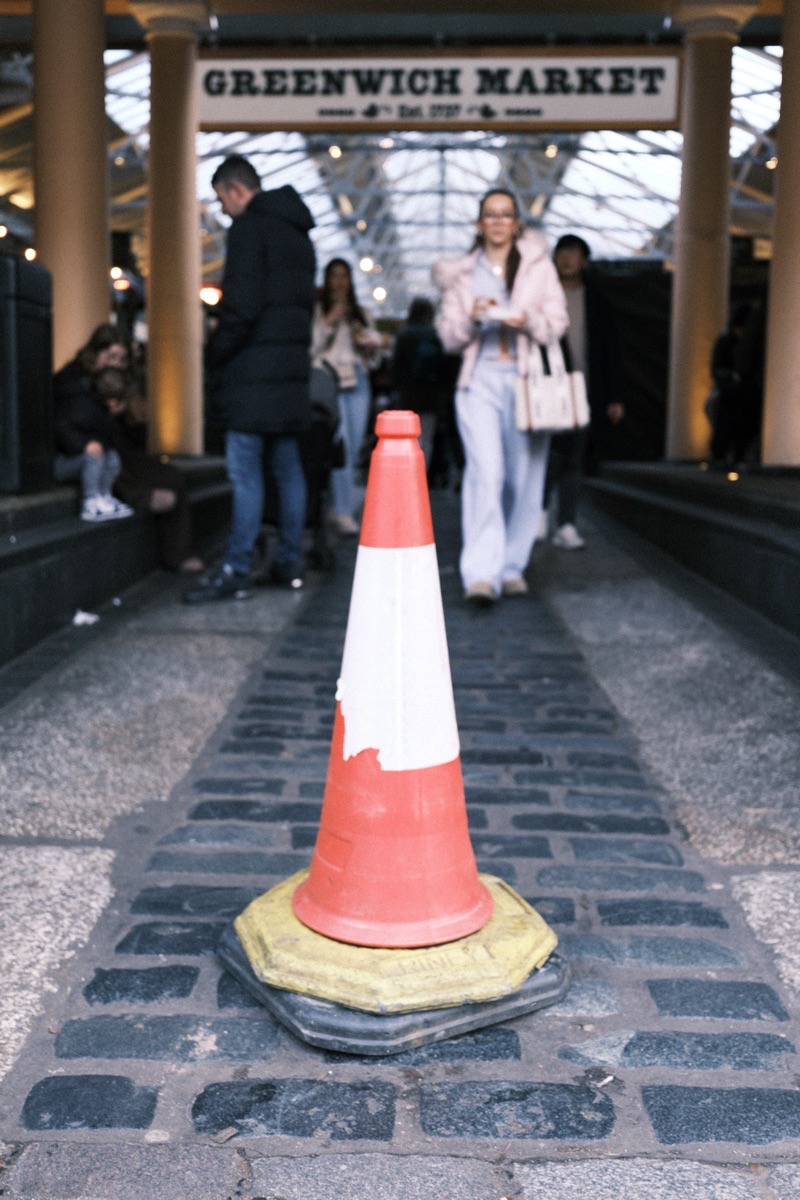
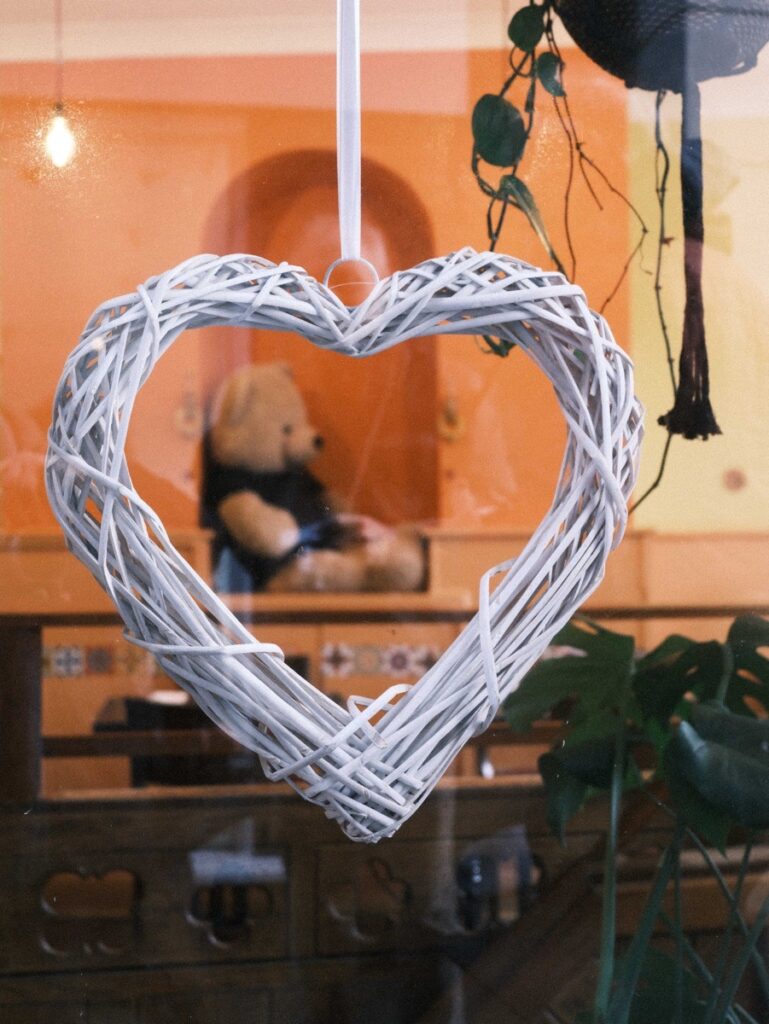
The festival is a great meeting point for photographers. I’d already attended the morning talks and, over lunch, done an impromptu photowalk around Greenwich with a colleague, Peter Thompson. So the day was already off to a strong start.
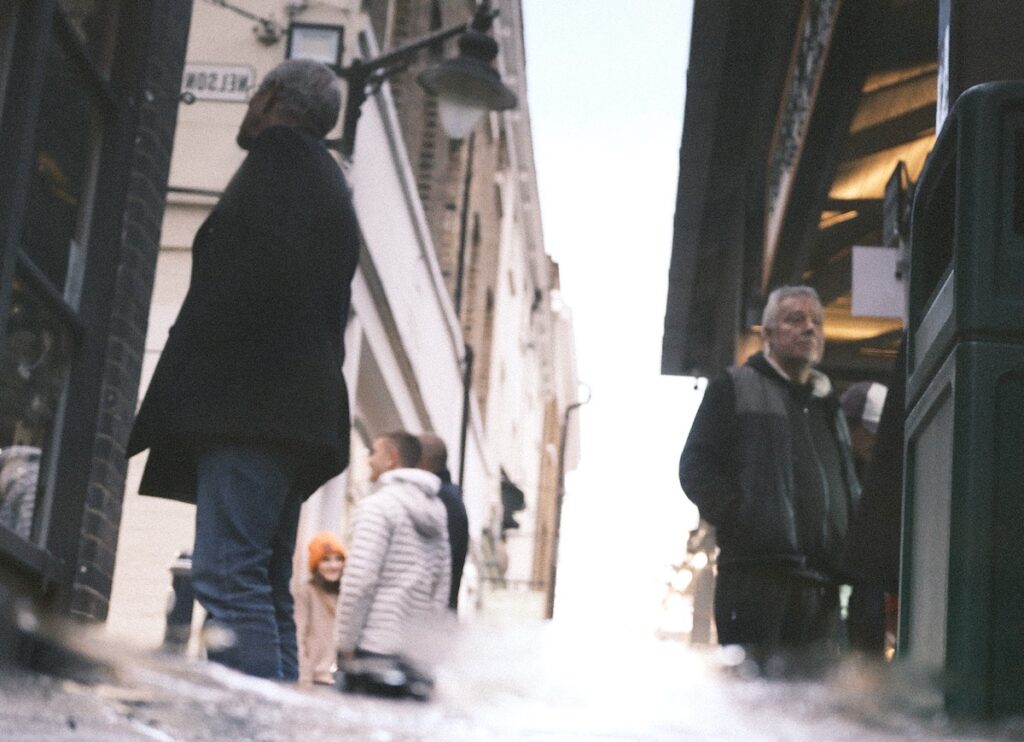
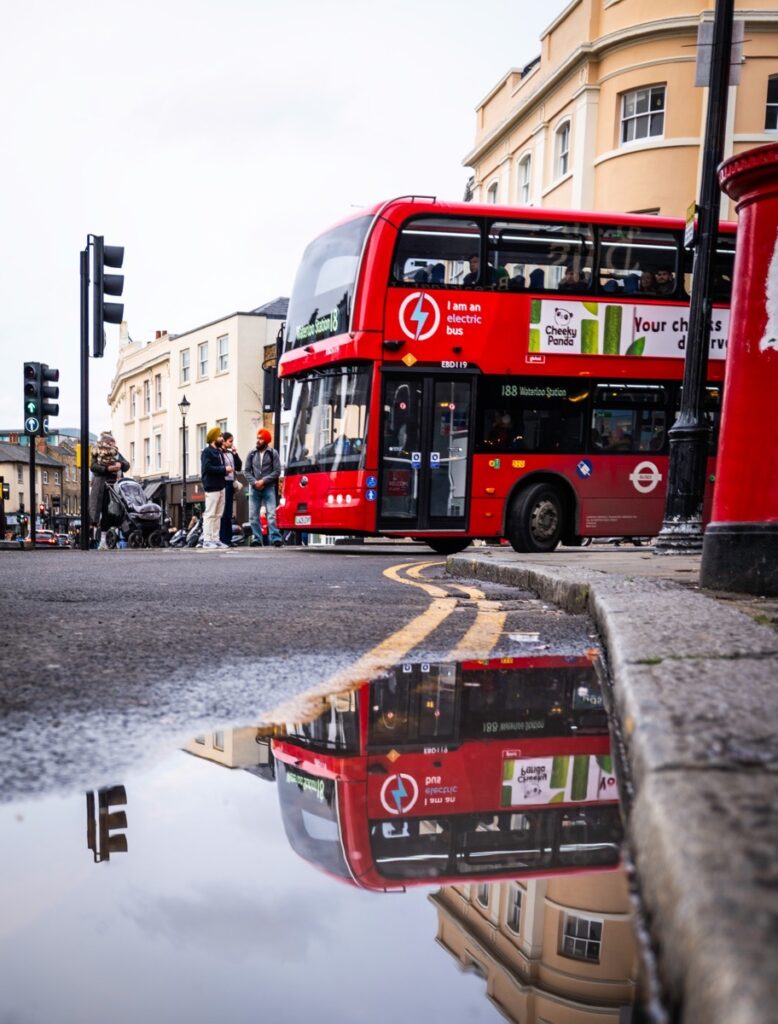
Reflections in a puddle of shoppers at Greenwich Market.
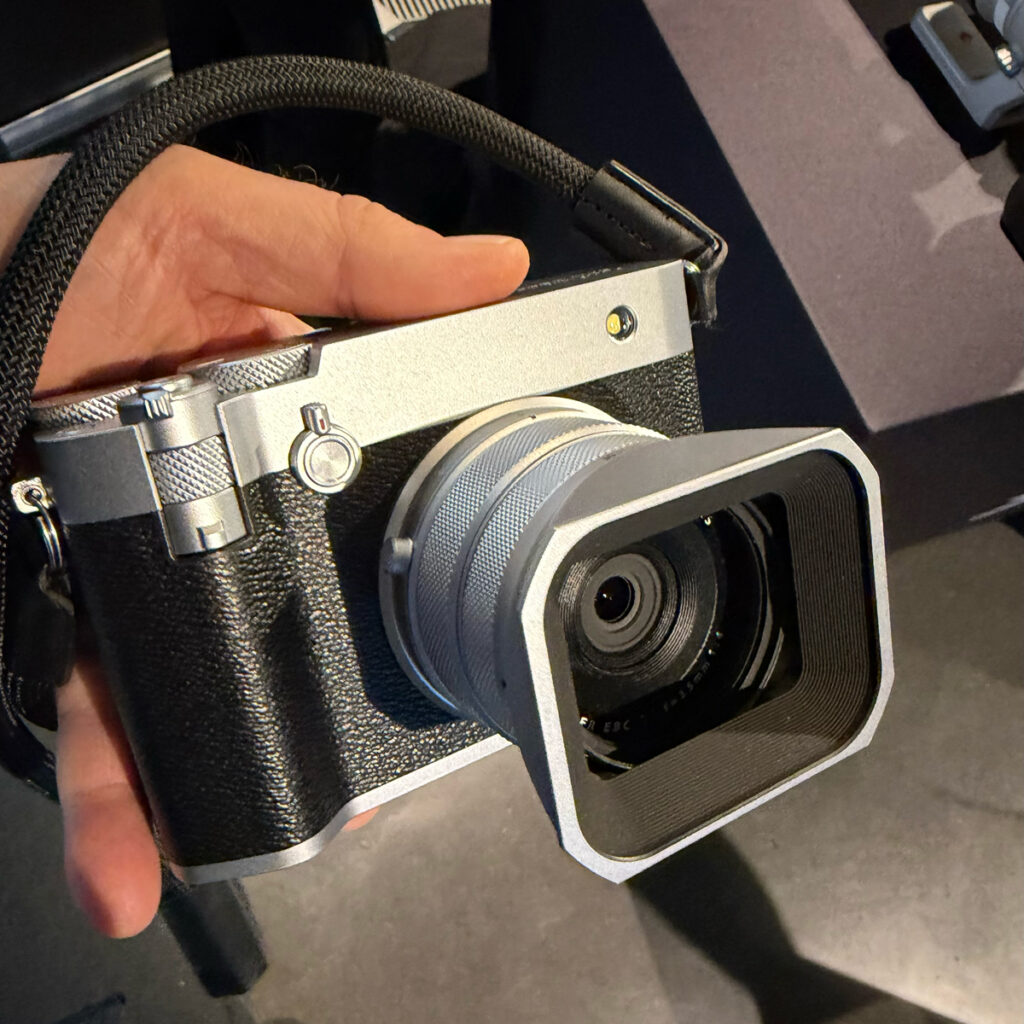
At the FujifilmUK stand, I signed out the GFX100RF for the hour-long session. It’s noticeably larger than my X100VI, but still comfortable to hold one-handed. I wrapped the strap around my wrist, my preferred way of carrying a camera, and followed Bal (Mr Whisper) towards Greenwich Street Market. He kicked things off with some street photography tips, revisiting ideas like leading lines, framing, and reflections, which was a useful refresher.
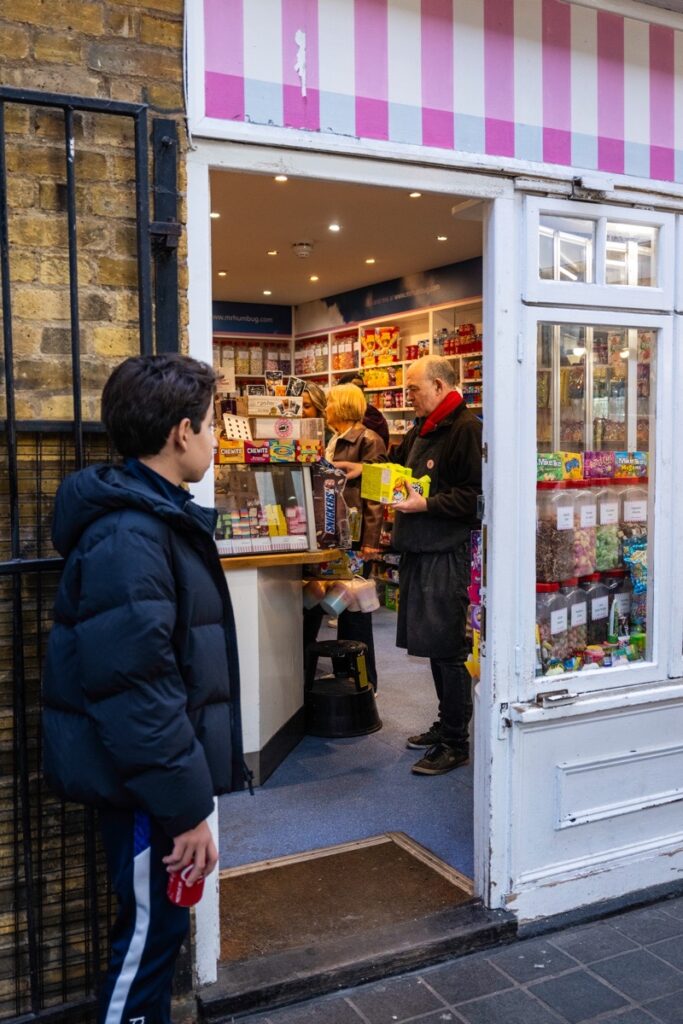
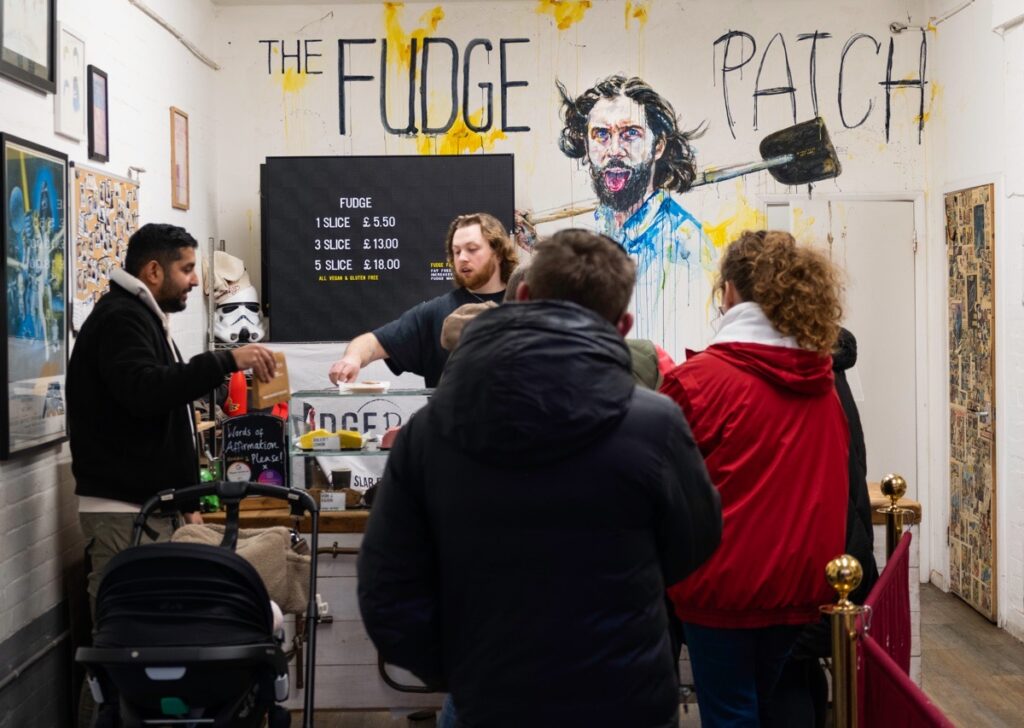
Looking in at the sweet shop in Greenwich MarketMake fudge not war but choose carefully.
A few shots in, I started to get the feel of the camera. I normally use back-button focusing on my other Fujifilm camera, so it took a little time to adjust. Greenwich Market is an enclosed square with entrances on each side, full of activity and photographic opportunities.
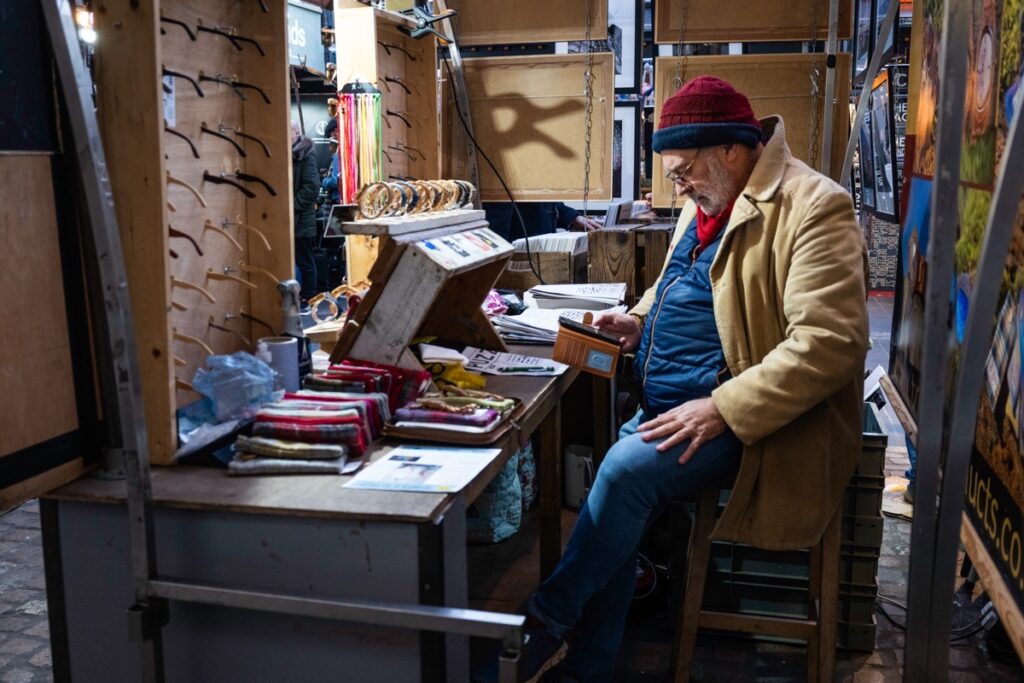
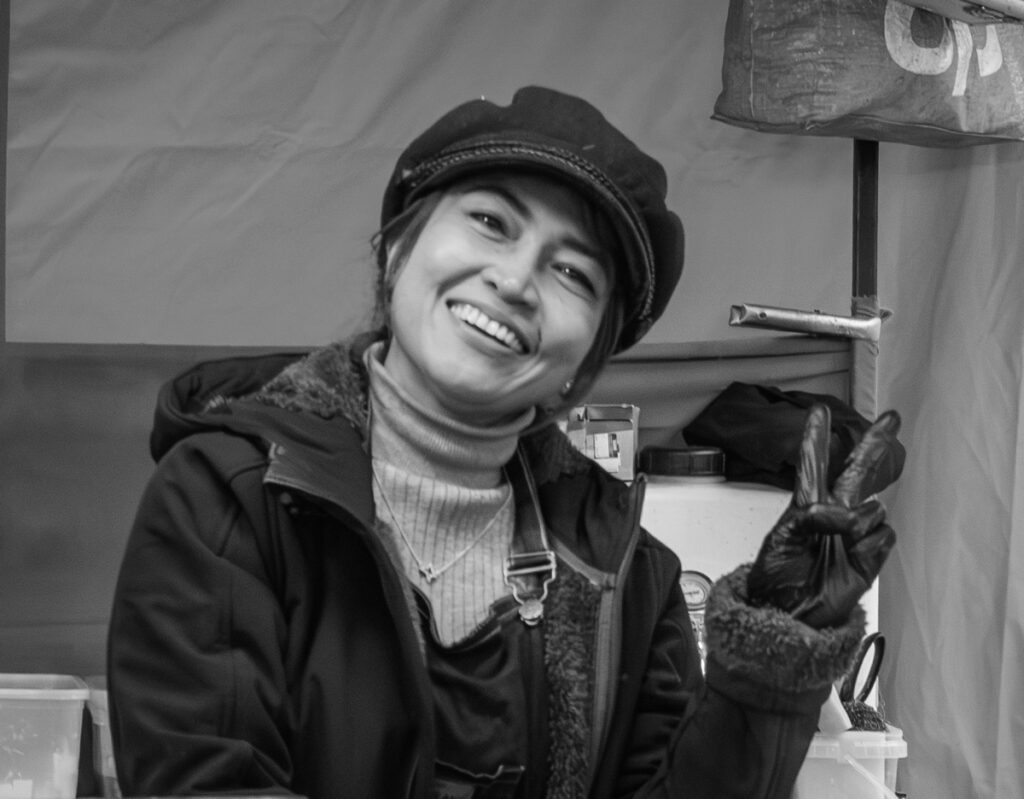
Portrait of a shop keeper at Greenwich market.
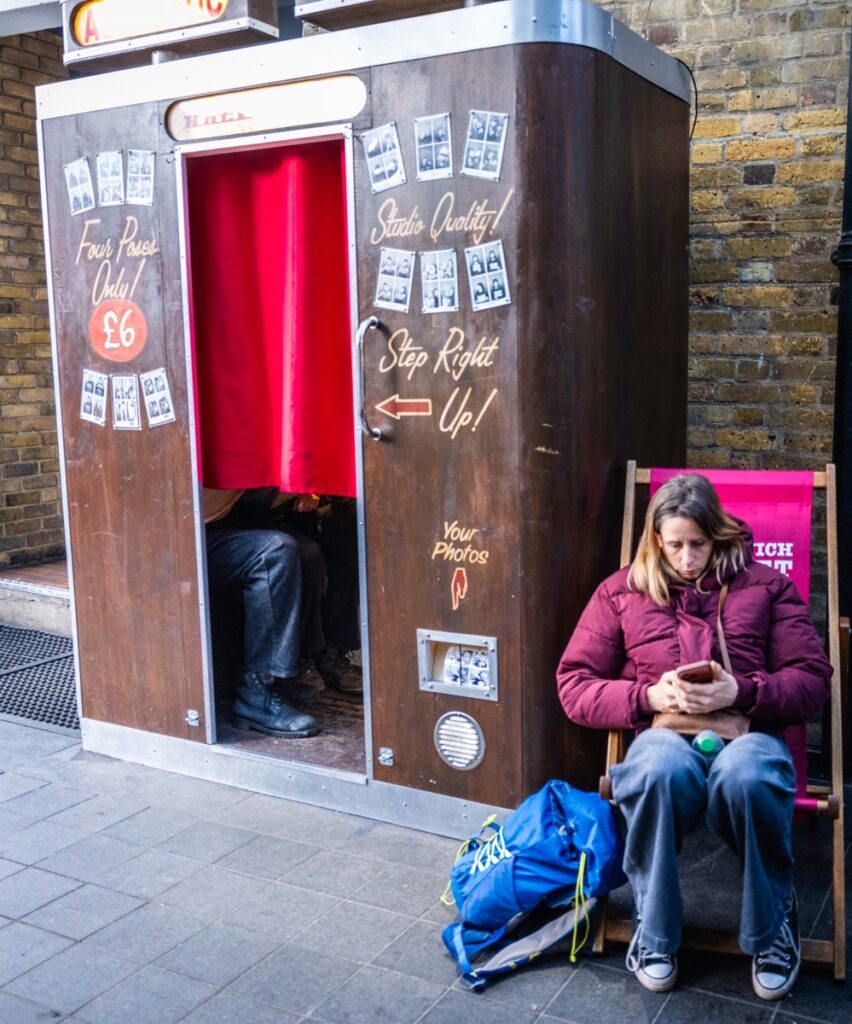
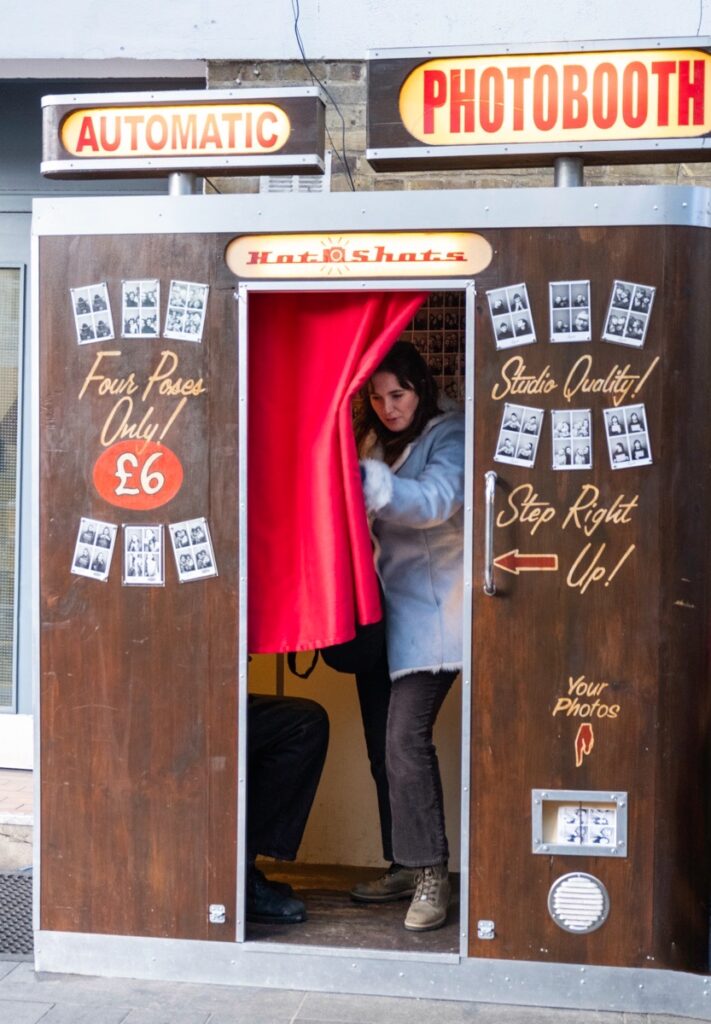
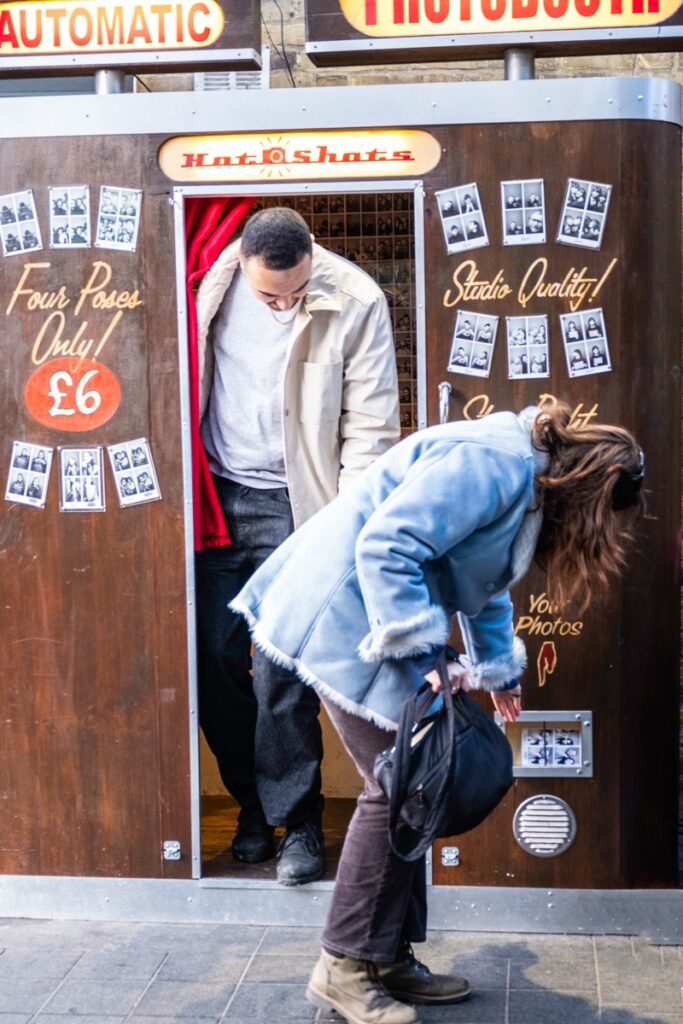
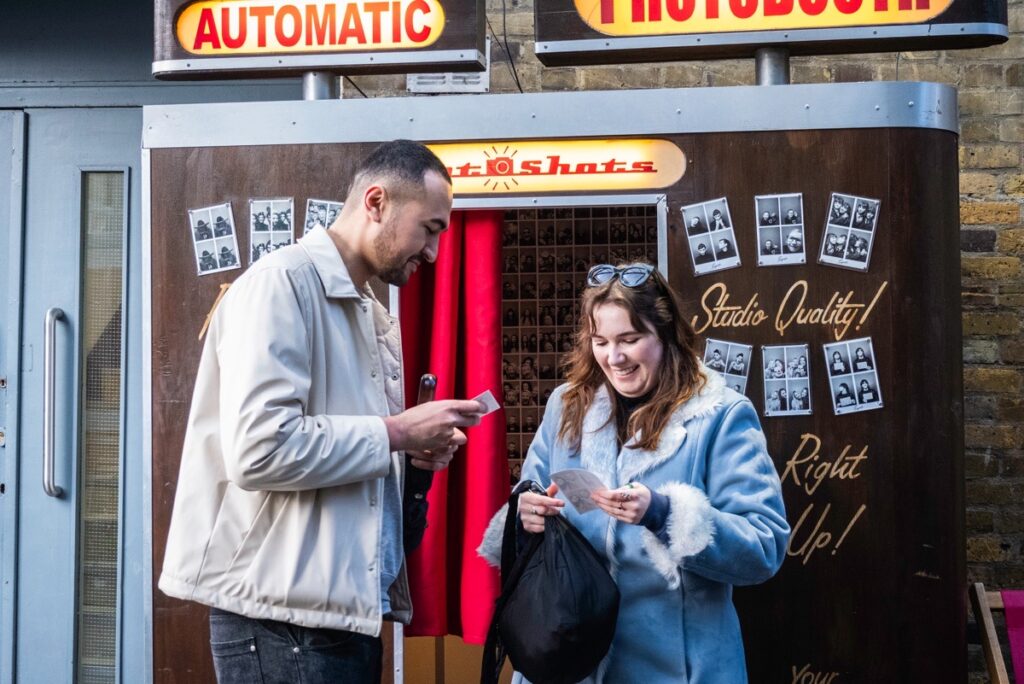
Near a photobooth, Bal noticed I’d accidentally set the camera to digital zoom, caused by pushing an unfamiliar dial. Once corrected, I was back on track. The GFX100RF was a joy to use as I moved through the stalls, and the time flew by.
Taking the picture.Drawback the curtain.See the result.They look so good.
–
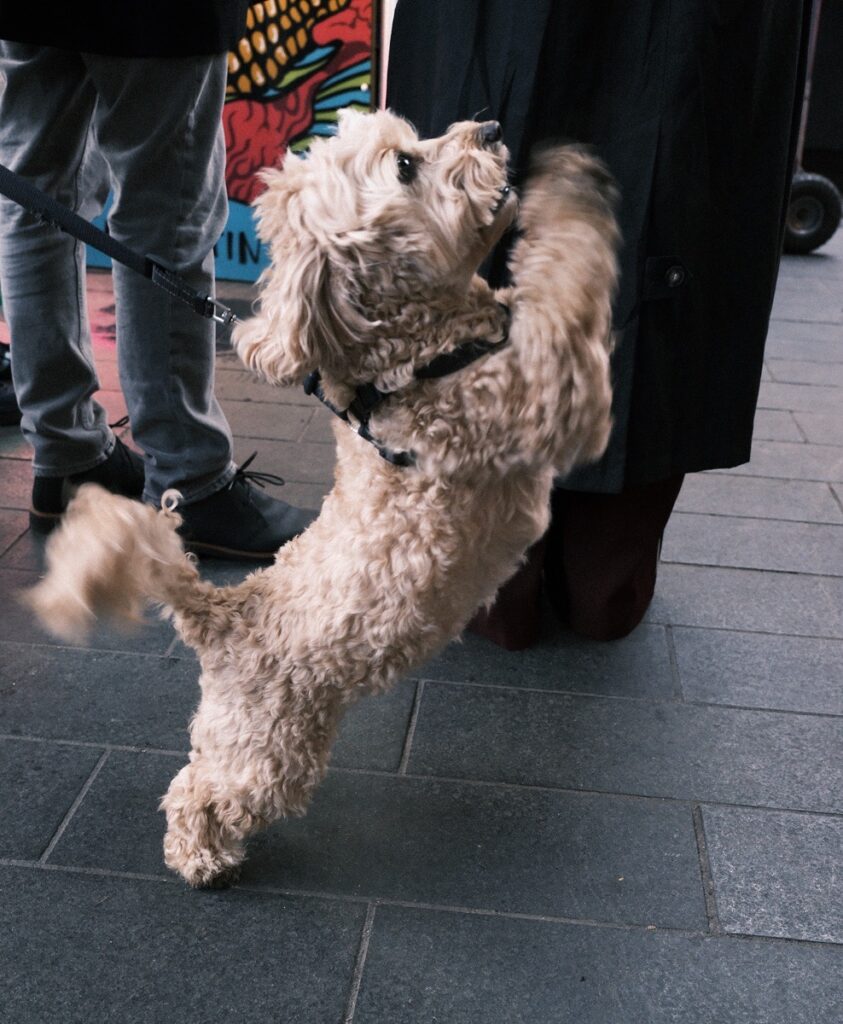
A dancing dogJust be happy
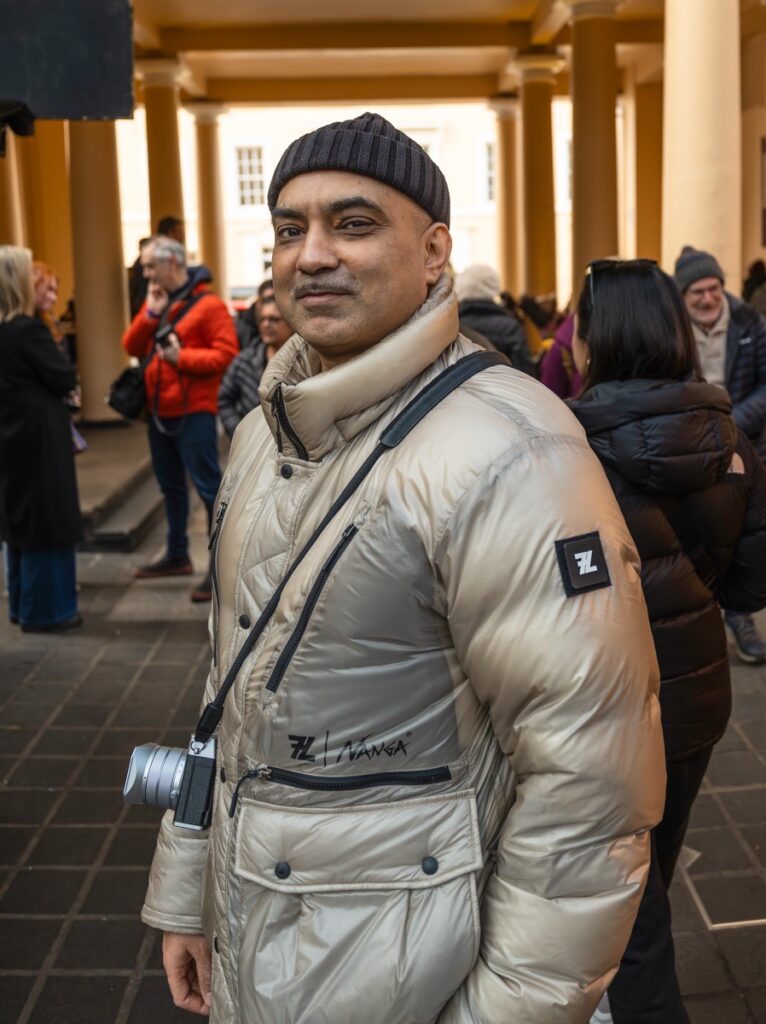
– When we regrouped, I asked Bal if I could take his portrait, which he kindly agreed to. I took several shots by the market entrance, but again hesitated over my focus settings. Bal quickly switched on eye detection. This was another good reminder of how important it is to know your camera well and adjust settings quickly.
Portrait of MrWhisper taken at the entrance to Greenwich Market
At the end of the session reluctantly, I handed the camera back and checked the images on my X100VI, only to find they appeared completely out of focus. I was despondent, even though I’d thoroughly enjoyed the session.
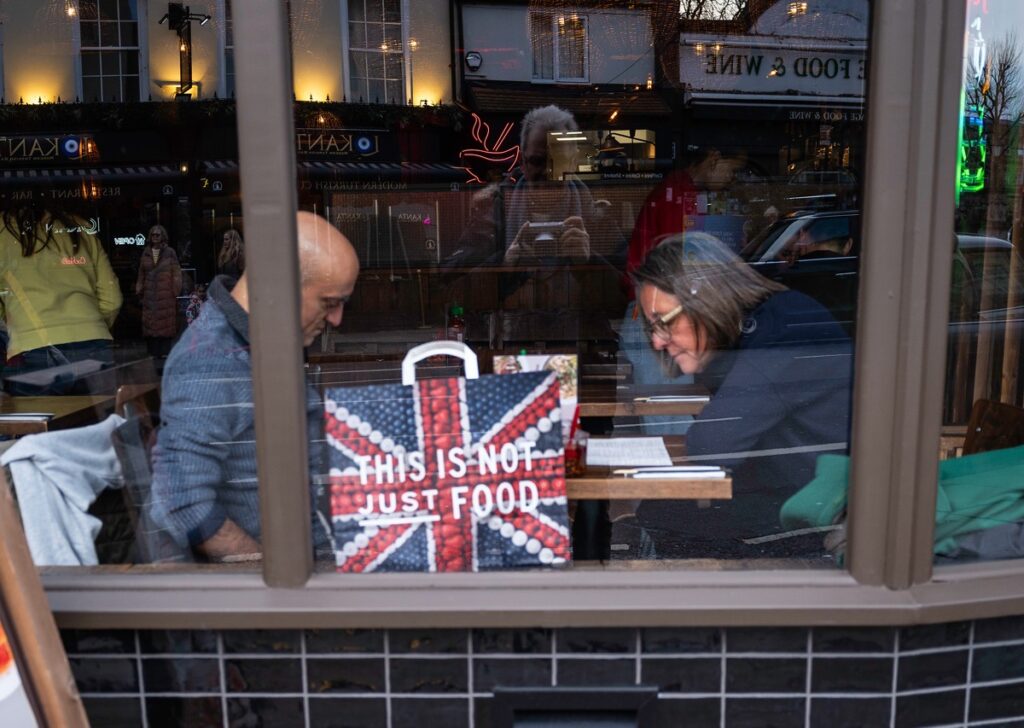
The M&S bag says it all!
Back home, I checked the files properly on my computer. Relief! Most were in focus. My X100VI simply couldn’t handle previewing the large files many in excess of 130Mb. Processing such large images was demanding (and my laptop ran hot), but I was very pleased with the results.
Reflections of the 188 bus.
Many thanks to Mr Whisper for a fantastic session, and to Fujifilm UK for letting me use the GFX100RF. Now I just need a loan to buy one. Would I get the GFX100RF? Yes, absolutely.
The GFX100RF such a great street camera.
Finally a big shout out to MrWhisper. I would recommend going on one of his night photography courses around London. Details on his website.
Druids Heath is just a place I pass through—a shortcut home and a fast route that I have taken many times after events at the University of Birmingham or in Selly Oak and Bournville. Passing through the area, I often wondered about the mix of tower blocks and green spaces. I remember passing a lively pub, although its name always escaped me. My drive through would last around five minutes, ending at the Maypole and onto the bypass leading to the motorway back home.
Bell’s lane. the main thoroughfare passing through Druids Heath
Druids Heath remained an enigma until I stumbled upon a National Trust post which led me to the National Trust’s Back to Backs website. There was an advert for a walking tour of the area, linked to the slum clearance projects of the 1960s, such as the Back to Backs. Sparkling new estates had sprung up during that era, with Druids Heath at the forefront. My family came from Manchester, so I never learnt about the clearance of Birmingham’s slums. However, I did have University friends who lived in the Hume crescents in the late seventies. I have many stories of visiting Hulme when a student in Manchester.
Jayne Murray, the resident artist of Place Prospectors.
The walk around Druids Heath was organised by Jayne Murray, the resident artist of Place Prospectors. We gathered at the terminus of the number 50 bus, where Jayne introduced herself and handed out a set of postcards. Each postcard was to act as a signpost for our journey around the estate. The first depicted a map and a picture of the bus stop. As we began our walk, we found ourselves on the border of the city with the green fields of Bromsgrove and Worcestershire on the other side of the road. There was a stark contrast between the green countryside and the houses and towers of Druids Heath. The houses were built in units—some with garages and living quarters above, others resembling small terraces. Tower blocks punctuated the landscape, standing over the lower-raised houses. As we moved along, these towers became an ever-present feature, imposing themselves on the scenery.
A typical example of low level housing in Druids Heath.
Despite the low-grade litter scattered around the estate, it was clear that many residents took pride in their homes, adding personal touches to make the place welcoming. Jayne shared background details about the area, and the postcards were a clever prompt, allowing us to see how the estate had changed over the years. For example, the land along Bells Lane was once used for farming, and remnants of its agricultural past were still visible in the bushes that had once formed natural borders.
An example of the concrete architecture on the estate.Empty dustbins
We stopped at several landmarks, including the former pub called the Gladiator. Now I remember its name! Jayne explained that where there were once three pubs, there are now none, and she lamented the loss of the community spirit that disappeared with their closure. We also heard about the Dell; a large area of heathland once earmarked for development. A determined community fightback led to the cancellation of these plans, and the area is now a haven for wildlife.
The heathland of the Dell overshadowed by electricity pylons.
The final stages of the walk focused on the towers. Some have been demolished, while others stand empty, deemed unsuitable for habitation. Hillcroft House, for instance, stands vacant next to a row of shops—some are still in use, others abandoned. We passed two demolition sites: Heath House and Moundsley House. Both towers are now gone, leaving only grass in their place, with no new structures having yet been built. The library has since been replaced by the Druids Heath neighbourhood office and the youth club was still there. Using postcards with images of the towers mid-demolition, we aligned our photos to capture the present-day view, a poignant reminder of what once stood there.
The towers impose themselves over the undelating landscape.Leading lines to the towersHillcroft House stands emptyWelcome to Druids Heath.The site where Moundsley House once stood.
Jayne then led us up a hill to a green metal fence enclosing a large empty space. She recounted the story of Baverstock School, once a jewel in the estate’s crown. Built in 1969, its headteacher, Mr Perks, was dedicated to giving pupils the chance for a brighter future, and the school gained numerous accolades. However, after his retirement, the school’s fortunes declined, plagued by financial mismanagement and poor governance. It closed in 2017, with bulldozers arriving in 2020. The story saddened me, and I struggled to understand how such a vibrant institution could fall into ruin. Today, all that remains is an empty space, a postcard, and memories cherished by former staff and pupils.
There is nothing to show that Baverstock School once proudly stood here.
As we neared the end of our walk, a short footpath brought us to Kimpton Close, surrounded by three tower blocks: Saxelby, Kingswood, and Barretts Houses. Concrete buffers lay uprooted and scattered around the area. These buildings, now empty, await their fate. The 13-storey towers—used as a backdrop for the BBC drama series This Town, which explored the birth of ska in Coventry—stand as imposing relics of the past. I took many photographs, drawn to their photogenic yet haunting presence, and reflected on the families who once lived there. The setting sun seemed to know that their time was coming to an end.
The silhouettes of the three tower blocks against the setting sun.Looking up at Barretts House. Empty except for a few remnants of previous habitation.Graffiti writing on the entrance doors
Our final stop was a surprising landmark. Druids Heath is one of the highest points in Birmingham, and surrounded by the towers there was a trig point. Jayne joked that if we looked east, the next highest place would be the Ural Mountains. With the cold wind picking up on that late Saturday afternoon, I had no reason to doubt her.
The trig point in Druids Heath with the towers forming a backdrop to the landscape.
In our pack was artwork inspired by Druids Heath residents. The final postcard bore the words I am not going to panic, from the Moving Stories project. This artwork, by Jayne and Jean, one of the last residents of the Brookpiece tower block overlooking the trig point, depicted the long-reach of the proposed demolition. The tower was in the jaws of a pincer which outlined the area. There is a lot of concern and uncertainty about what is planned to be demolished and what will replace the present buildings.
We concluded our walk with a group photograph and I departed for home. Jayne and others headed to the Outpost Arts Centre for a screening of the film The Great British Housing Disaster. I later watched the film on YouTube, finding it a harrowing yet informative background to the building expansion in the sixties. The mismanagement and misplaced decision making from Government and building contractors remains a major problem to this day. Will the future lead to better things? That is a difficult question to answer based on past history of the buildings on Druids Heath.
Taken from the Instagram account of @jaynemurrayartisThe lights on Pound road
On my way back to the car, I passed the mural for Druids Heath by Mohammed Ali. The golden light of the setting sun enhanced its vibrant colours. The mural’s theme of safety and compassion reflected the community’s spirit and the hope for togetherness.
The artwork by Mohammed Ali symbolising the community spirit.
At the number 50 bus stop, where two buses waited, I was reminded of the first postcard Jayne had handed out. Back home, I looked through my pack again, matching my photographs with the postcards. I would encourage anyone to visit the Moving Stories website and read about the residents’ experiences of life on the Druids Heath estate. Their words—flooding, cold, damp, frustration, and loss of hope—paint a poignant picture of the challenges they faced.
The number 50 bus terminus.
Though Druids Heath was once just a shortcut on my way to Birmingham, this walk gave me a glimpse into its rich history, its struggles, and its community spirit. It is no longer simply a place I pass through but one I now understand more deeply.
Thank you to Jayne and the team that organised the walk around Druids Heath. Jayne was accompanied by Clare, who is an artist and former architect. Clare provided background information as to how the houses and towers were built. I found this to be an excellent follow on from my visit to the National Trust Back to Backs property. I have written a blog about my visit there and there is a link below. I shall be visiting the exhibition “Moving Stories” that links with the walking tour that I described in this blog.
I have also added a link to “The Great British housing disaster” which is essential viewing. The documentary unravels the mismanagement and poor quality control of the building industry in the 1960s. The people who bore the brunt of this disaster were ordinary people many of whom lost their lives when buildings collapsed or caught fire such as the Grenfell Tower fire.
The dull and gloomy weather over Christmas has led to several fog-drenched mornings, which have lingered throughout the day. For photographers, such conditions are ideal for adding atmosphere to compositions. I set off towards Baddesley Clinton, where the presence of the canal network generally guarantees fog. I drove to Hay Wood but stopped by the entrance to Baddesley Clinton on the way to take a picture of the tree-lined entrance. Another good spot is the public footpath on Netherwood Lane. Here, the line-up of trees with a hedge is the perfect location for a sunset picture in the summer. In the winter, the branches add different shapes to the landscape. The fog provided an eerie landscape.
Windows in the fog. (Footpath off Netherwood Lane, near to Baddesley Clinton.)Entrance to Baddesley Clinton with dog walker.
Hay Wood has featured in my blog over the years. There are several places in the woods that I like to visit. In spring, there is one area with a carpet of bluebells, and I wondered how it would look in the fog. I brought my tripod with me, and most of the pictures were taken using a long exposure setting, especially in the woods where the light was poor. There was some colour from the remaining leaves. The last few pictures show the oranges and greens of the wood.
Dancing Branches in the foggy landscape.Trees standing in the fog.Colours of winter in Hay WoodOrange and green colours in the woodland.
I am pleased that the pictures worked out because I got a flat tyre on the way back and had to wait two hours for the recovery man to arrive. However, I was soon back home editing the pictures. You will see that I varied my black-and-white treatments, either adding a high-key effect or using lots of contrast.
The Escape route, Hay Wood.
These are my settings for each of the pictures, tripod used where stated:-
The Escape Route f/11, 0.4s, ISO 100 – Canon EOS 5D Mark IV, EF 70-200mm – Tripod Windows in the fog. f/11, 0.3s, ISO 100 Canon EOS 5D Mark IV, EF 70-200mm – Tripod Entrance to Baddesley Clinton F/5.6, 1/125, ISO 320 – Fujifilm x100vi Dancing branches. f/11, 1s, ISO 100 Canon EOS 5D Mark IV, EF 24-70mm – Tripod Trees standing in the fog F/5.6, 1/125, ISO 320 – Fujifilm x100vi Colours of winter F/5.6, 1/100, ISO 2000 – Fujifilm x100vi Orange and green F/11, 0.5s, ISO 125 – Fujifilm x100vi – Tripod
As I mentioned Hay Wood has featured before in my blog and the landscape is transformed in Spring
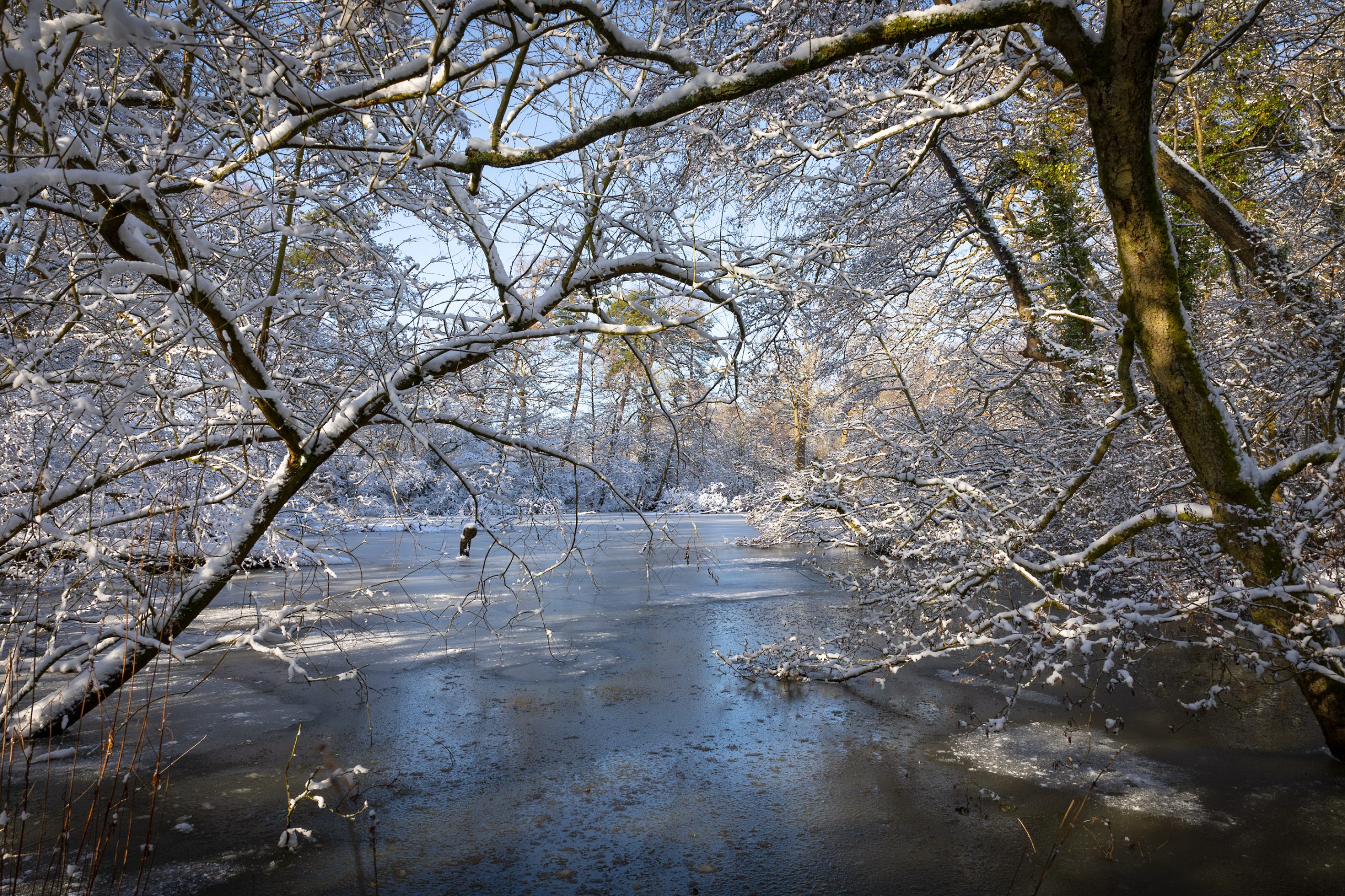
When the snow first fell the skies were overcast and whilst there was a some beautiful snow scenes, I longed for a blue sky to provide some colour. The next day the sun shone and there were no clouds in the sky. I planned my walk to take me over fields to Widney Road allowing me to approach Brueton park and the nature reserve from the west.
Lea Wood in the snow
My first stop was Lea Wood nature reserve which I had not visited before on my travels. The wood used to be a tree nursery and the trees now fully grown are aligned in lines. This creates many leading lines along the paths in the wood. There were several walkers in the wood so I was able to compose some eye-catching pictures with leading lines towards the silhouettes of people . The low level of the sun also produced lovely light that I was able to shoot towards the sun with the trees as a backdrop. I hung around for some time fascinated by the trees and the patterns caused by the light.
Sunlight in the woodsSunlight on the tree branchesA leaning treeSnow on the treesTrees on the way to Breuton Park
Finally I moved onto Brueton Park proper. It was very muddy despite the frozen ground. When I got to the river Blythe, I made the decision to go into the old Wood on the west bank to the River Blythe. The place was deserted and following the muddy path, I threaded my way deep into the wood. I arrived at the north end of the water pool which interestingly is unnamed on the map. The sun was shining brightly but the thick canopy of the trees diffused the rays. The path led around to the south side and here I was able to get close to the water’s edge. With the light low, bright and just right a beautiful scene opened up. I was so pleased with the pictures of the water and the framing from the trees. It was a richly rewarding photo walk with many different variations of the snow lying on the ground reflecting the sun. It was a much different day than yesterday and very productive.
The river BlythePath around the poolThe pool in Brueton Park Woods
Photo tip. Don’t be hasty in taking your pictures and try and slow down. I was very excited at first especially in Lea Wood. Then with time I started to enjoy myself in the woods and came away with many different pictures. I had my iPhone, large Canon camera with lenses plus my Fujifilm x100v. Yes it was a bit over the top in terms of photographic equipment but I was glad that I had all of them with me.
We use cookies on our website to give you the most relevant experience by remembering your preferences and repeat visits. By clicking “Accept”, you consent to the use of ALL the cookies.
This website uses cookies to improve your experience while you navigate through the website. Out of these, the cookies that are categorized as necessary are stored on your browser as they are essential for the working of basic functionalities of the website. We also use third-party cookies that help us analyze and understand how you use this website. These cookies will be stored in your browser only with your consent. You also have the option to opt-out of these cookies. But opting out of some of these cookies may affect your browsing experience.
Necessary cookies are absolutely essential for the website to function properly. These cookies ensure basic functionalities and security features of the website, anonymously.
Cookie
Duration
Description
cookielawinfo-checkbox-analytics
11 months
This cookie is set by GDPR Cookie Consent plugin. The cookie is used to store the user consent for the cookies in the category "Analytics".
cookielawinfo-checkbox-functional
11 months
The cookie is set by GDPR cookie consent to record the user consent for the cookies in the category "Functional".
cookielawinfo-checkbox-necessary
11 months
This cookie is set by GDPR Cookie Consent plugin. The cookies is used to store the user consent for the cookies in the category "Necessary".
cookielawinfo-checkbox-others
11 months
This cookie is set by GDPR Cookie Consent plugin. The cookie is used to store the user consent for the cookies in the category "Other.
cookielawinfo-checkbox-performance
11 months
This cookie is set by GDPR Cookie Consent plugin. The cookie is used to store the user consent for the cookies in the category "Performance".
viewed_cookie_policy
11 months
The cookie is set by the GDPR Cookie Consent plugin and is used to store whether or not user has consented to the use of cookies. It does not store any personal data.
Functional cookies help to perform certain functionalities like sharing the content of the website on social media platforms, collect feedbacks, and other third-party features.
Performance cookies are used to understand and analyze the key performance indexes of the website which helps in delivering a better user experience for the visitors.
Analytical cookies are used to understand how visitors interact with the website. These cookies help provide information on metrics the number of visitors, bounce rate, traffic source, etc.
Advertisement cookies are used to provide visitors with relevant ads and marketing campaigns. These cookies track visitors across websites and collect information to provide customized ads.