While organising a walk for the photographic group Negative Space, we explored Digbeth using the canals as our guide. After lunch, we headed back into town, walking via Shaw’s Passage. I was pleasantly surprised to find the community garden open, so as a group, we went in.
The entrance to the community garden
The garden is a small green space situated close to the HS2 works. In fact, the HS2 project is not particularly welcomed here, as one of my pictures shows. The walls of the garden are adorned with street murals several of which I have always wanted to see. Such colourful images add to the space’s character. A path around the perimeter leads to the back walls, where I met one of the volunteers, who was dressed as a bumblebee. (I have forgotten his name, though I believe it began with an H.) His striking yellow-and-black costume stood out, and he was more than happy to have his photograph taken.
Street art and bath tubsA resident bee keeperHS2 is not welcome hereArt on the walls
Compost was the main topic of conversation that day. A few members of Negative Space were particularly enthusiastic about learning how the volunteers in the garden produce and distribute the compost. As it was early March, spring was only just beginning to emerge, so much of the garden’s work was focused on preparation. At the heart of the space is a beehive, though activity there was also just beginning.
Discussing the merits of compost.Watering can at the ready.Bee hive and flags
My aim is to return in the summer when the garden will be in full bloom and compare my photos from then to now. In the meantime, I hope you enjoy my record of this visit.
I was absolutely thrilled to learn that the sails were finally going to be placed back on Chesterton Windmill. This Grade I listed building holds so many cherished memories from before lockdown—a place to explore, take photographs through the changing seasons, or simply enjoy the historic beauty of this iconic location. During lockdown, the windmill became a refuge, a meeting point for family while maintaining social distancing. As a lover of landscape photography, the windmill has featured in many of my pictures. In fact, the Chesterton Windmill is an iconic location for many landscape photographers and is high on the list of Instagram influencers’ favourite buildings.
This classical view of the windmill with leading lines from the fields will soon have the addition of windmill sails.
Then, in the spring of 2021, the sails were taken down. There was no notice, no explanation, and no indication of when they would return. For years, the windmill stood without them—dignified yet incomplete. Over time, many local people gave up hope that the sails would ever be restored.
Behind the scenes, however, Warwickshire County Council had commissioned the production of brand-new sails, carefully crafted to honour the windmill’s heritage. The company appointed for this task was Owlsworth Conservation, specialists in the preservation and repair of historic buildings. Behind the scenes of apparent inactivity, both the council and Owlsworth Conservation had been diligently working through the challenges that come with such a project.
When I received an email from my close friend John Bray with the news that the sails were being installed, I was, as I said at the beginning, absolutely thrilled.
The newly made sails lie to the side of the Windmill as the supporting stocks are put in place.
The day arrived, and I gathered my cameras and set off for the windmill. When we arrived, the site was buzzing with activity. The sails were being installed using traditional, handcrafted techniques—pulleys and ropes at the ready. The only concession to the modern day was the use of a motorised articulated boom. One of the stocks that will hold the sails was already in place. Over the course of the morning, the second stock was hoisted into position. Although the sails would not be attached until the following week, the cross-bar mechanism was now ready to accept them.
The craftsmanship is evident of the newly constructed sails (plus attached earthing metal tape.)
The team was happy to talk about the process and the dedication required to restore the windmill. The work demanded skill, patience, and perseverance. The weather was bright, with blue skies and white clouds, but it was bitterly cold. The previous day, the restoration had continued despite a wave of hailstones. Yet none of this dampened the enthusiasm of the men working on the windmill. A video of the work being done is on the BBC website
From above, the work aims to pull the second beam upwards.From below, all hands keep the beam ready as it is hoisted upwards.The cross bars are ready for the addition of the sails.Paul Millwright of Owlsworth Conservation with the windmill in the background.
I look forward to seeing the sails in place, and in the coming months, my family will visit to relive our treasured memories of this beloved landmark. This ancient monument has witnessed so much change over the centuries, standing tall through shifting landscapes and history itself. Now, as it regains the sails that define it as a windmill, it is once more ready to embrace whatever the future may bring.
The team includes members of Warwickshire county council and Owlsworth Conservation
I have included one of several blogs I have written about Chesterton Windmill. The blog featured was written in 2019 and shows how the windmill looked with sails prior to their breakage.
I encouraged my daughter and grandson to join me on a walk to see the HS2 works next to 16 Acre Wood. It’s now 2025, and it’s time for an update on my visits to the site. These visits began in 2021, and I’ve kept a diary documenting all the changes that have taken place over the years.
Over the hill and far awayHS2 signsNew bridges on the line.Concrete structures.Heavy machinery.The gate
We’ve had a lot of rain recently, and the walk reflected this as the footpath became quite muddy. When we reached the area, the first thing I noticed was the progress made with two bridges. A lot of concrete had been poured, resulting in two large structures. The special pond had also received some attention. The overgrown foliage had been cut back, and we were now able to see the water and grass more clearly. No trees have been planted around the pond yet, so it will be interesting to see how it fares over the coming summer.
Lots of numbersThe new pond.The old pond is still looking on.Nature is always near.The wood is a lot thinner.
Walking around the site on the weekend meant there were no concerns about taking photographs, which was a nice bonus. However, it was a long walk which Noah was not so happy about!
Walking along the footpath.
This is an update on a continuing story on 16 Acre Wood and the intrusion of HS2. Feel free to read the my other entries starting with the one highlighted below.
Over 40 years ago, my family took a day trip to Kew Gardens. We had a flat in London and were exploring Kew as part of our adventures in the city. I had just started my job as a dental house officer at Guy’s Dental Hospital, marking the beginning of a new chapter in my life.
The view over the lake to the Botanical Brasserie.
Fast forward 40 years, and I returned to Kew Gardens with Sandy to attend a reception for the International Garden Photographer of the Year (IGPOTY) awards and to receive a certificate for coming second in the wildflower category. We were fortunate to have free access to the gardens, and after weeks of grey weather, the sun finally appeared. The day out coincided with my birthday, 14th February, and I was looking forward to the visit.
The exhibition of International Garden Photographer of the Year/
When we arrived at Kew Village, it was quiet. After initially walking in the wrong direction, we corrected ourselves and found the main village on the opposite side of where we had arrived. We strolled along the pretty avenues, past the lively shops, and made our way to Victoria Gate. Once inside the gardens, we had some time to explore and visited the Palm House. The deep green foliage, humid conditions, and old Victorian ironwork made it a fascinating place. I particularly enjoyed the circular rooftop walkway. The high-level views through the condensation-covered windows were worth the climb up the spiral metal staircase.
a Wheelbarrow inside the palm house.
Kew Gardens is filled with beautiful tree-lined avenues, and we walked towards the Temperate House, which was near the exhibition venue. Along the way, we saw the Great Pagoda in the distance, neatly framed by the trees.
The avenue leading to the Great Pagoda
The IGPOTY reception was held in the Marianne North Exhibition Room, an enthralling space. Marianne North had hand-painted flowers from around the world, and the walls were covered from floor to ceiling with exquisite watercolours of flowers from Singapore, Borneo, and other exotic locations.
Marianne North Exhibition Room
After the presentation and collecting my certificate, Sandy and I went outside to see the International Garden Photographer of the Year display boards. By then, the sun was shining brightly, and the crocuses were just beginning to peek through, adding a welcome splash of colour after a dull, grey winter. It was an uplifting sight.
A splash of colour
Before leaving, we had time to visit the Temperate House, where I once again took a walk along the rooftop walkway. Afterwards, we strolled back along more avenues to Victoria Gate and made our way home on the tube.
People watching in the temperate house.
This was a wonderful experience to revisit after so many years and I hope to be back again in the future. I have another post about my prize winning entry which you may wish to visit.
The Birmingham Light Festival has brightened up the city as look to the end of winter. Light festivals have been held previously, and this year, the company Opus supplied 11 imaginative light installations. Although many other activities were taking place, the BBC was planning a feature on the lights. I tagged along with John Bray, and we systematically tracked down most of the installations. It was also an opportunity to try out my night lens filter for my Fujifilm X100vi which was a present by my daughters. I was eager to try it out.
‘The Roof of Stars’ lights up Thorp Street, and transforms the area around Birmingham Hippodrome’s Stage Door. It was fun trying to capture both the cars and the reflections of the stars. Near to the main entrance of the Hippodrome, there is a peace poem – the words are very much needed at present.
The Roof of StarsPeace Poem
‘The Light Door’ at New Street Station was very bright. There were also many people around and catching either a clear shot or getting one where they were interacting with the light was not straight forward. I soon realised that taking pictures of these light installations was going to be tricky due to their placement and the challenge of capturing the atmosphere of people interacting with the displays.
The light door
The Mailbox featured a fruit machine installation, “Positive spin”. My Fujifilm did not have the wide angle view and I should have reached for my iPhone for a wide angled view. As we walked towards Gas Street Basin and Centenary Square, we spotted a light boat passing by on its way to the Mailbox, allowing us to capture the scene at just the right moment. There were volunteers from the Canal and River Trust who had been involved with the lights on the narrow boat.
Positive SpinThe narrowboat of light arrives at the Mailbox
Centenary Square had two installations: “Dance on Lava” Floor is LAVA x Silent Disco and “Night Badminton.” People were having fun especially on the dance floor. The badminton installation had a purple shuttlecock which was difficult to follow against the city lights and the dark night sky. The people playing the game did not seem to mind.
Dance Floor is LavaNight Badmington
I was not disappointed with the last three installations we visited. The first was “Ideas happen here” in Newhall Square, where the fountains and water reflections provided plenty of opportunities for great pictures. Saint Paul’s Square had a bioluminescent fungus display in lights, offering numerous leading lines and a quieter setting that made it easier to capture images. The final installation was “Flux” in Snow Hill Square. Fortunately, I found a display board where I could rest my camera, allowing me to take a long exposure shot of the bars of light as they whirled around.
Ideas happen here.Mycelium networkFlux
The one I missed was Alright Bab but as this is a legacy installation, I have time on my side to take pictures of it. I returned on the Monday and took pictures of this iconic phrase.
Alright Bab.
Tracking down the light installations made for an super night of photography. I was pleased with how my lens filter performed, as it cut down on light pollution and allowed for very small apertures, resulting in some nice starbursts. Winter is almost over, and spring is just around the corner, but I always enjoy these light installations.
Here are my blog entries from previous light festivals in Birmingham to enjoy.
The Stratford-upon-Avon CanalLooking out over bridge 56Leading lines to the tree
This walk took us to the Edstone Viaduct, a spectacular canal aqueduct that runs over the Birmingham to Stratford-upon-Avon railway line. We made our way from The View across fields, down to the railway line, which had an unguarded crossing. Crossing this we arrived at the road and made our way to the viaduct. On the canal, a few narrowboats were moored, but as it was a cold February lunchtime, there was very little movement. I always like crossing the viaduct as the towpath is lower than the water level and so you have a different view of the canal.
Watch out for the trainsFollowing the path
The towpath and fields were extremely muddy, so having good walking boots was essential. The Warwickshire countryside is picturesque and gently rolling, and even on a grey day, it offers interesting places to visit. The pictures from this walk capture the beauty of the landscape, showcasing how this part of the world remains charming in all weather conditions.
If you enjoyed this entry in my blog then please read about my 4 churches bike ride around the Warwickshire Countryside. I also enclose a pdf from the View with a map and further details of my walk.
Details of Edstone Walk (copyright with the View, Wootton Warren)
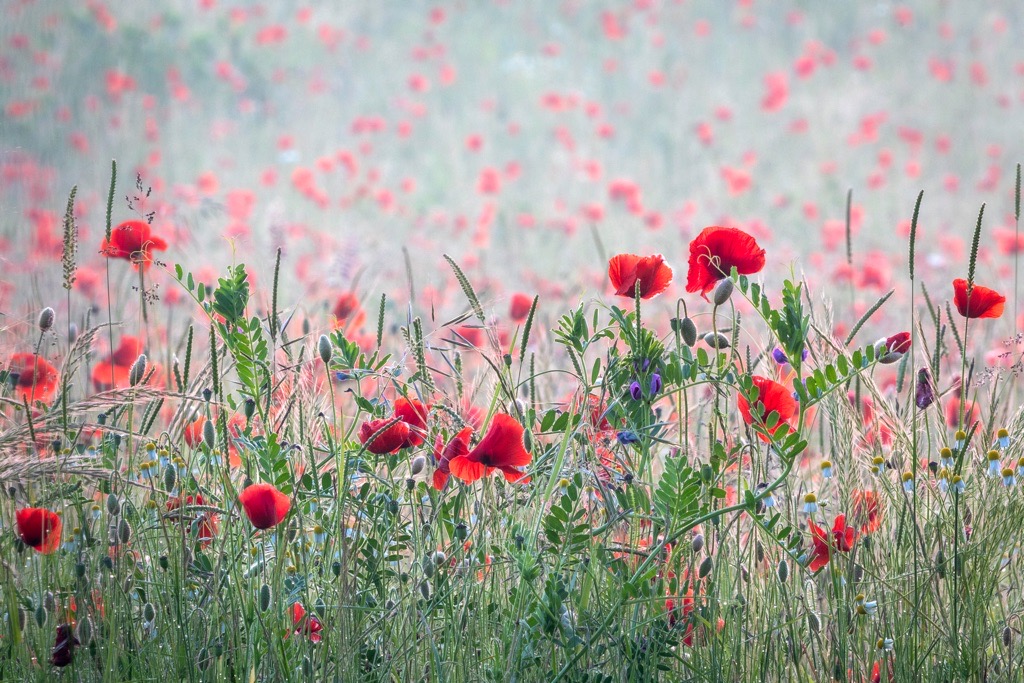
Little did I realise that a picture from a field in Kinver, Staffordshire, taken on a warm day in June 2024, would be displayed at Kew Gardens on a cold day in February. My photograph, Cool Light on the Poppies, was awarded second place in the wildlife category of the International Garden Photographer of the Year competition. I was invited to Kew Gardens to receive my certificate and attend the reception, which was a wonderful experience. I was very pleased with the result, and I enjoyed a lovely day at Kew Gardens, where the sun was shining and signs of spring were present.
Standing in front of my picture in the IGPOTY exhibition with my certificate.
This is my blog account of my visit to the Poppy field where I took the winning picture. I was also shortlisted with another picture of the sun streaming over the hill which is included in the blog.
The year may have started with plenty of rain, but that never stops me from hunting for reflections. I have a few favourite spots where I find good puddles, and here is a selection from the start of 2025.
Kingswood Junction after a very heavy downpour flooded the towpath.Taken with my Fujifilm x100vi of Gas Street Basin. There is smoke billowing out of one of the narrowboats.
Someone recently asked about my technique for taking such pictures. When capturing reflections, I use my iPhone, seeking out patches of water and anticipating how a reflection may appear. A key step is to get as low as possible to the puddle. This can be challenging, especially with particularly muddy puddles, like the one on Normandy Hill. One wrong step, and you could end up a muddy mess if you stumble into the water.
This reflection was taken from the surface of a very muddy puddle on Normandy Hill, Hillmorton, Rugby.
I position my phone so that the back lens is as close to the water as possible, just before autofocus engages. This creates a blurred background effect as the phone focuses on the nearest object. Since you are often crouching in muddy water while holding your phone, you must anticipate the outcome of your shot rather than seeing it perfectly in the moment. Using a larger camera—even a compact one—would be difficult in such conditions. Of course, larger cameras work well when photographing a lake beneath a mountain range, safely away from the water’s edge. However, the beauty of using a phone is its ability to capture reflections effortlessly during everyday walks. There are two pictures, in this gallery that have been taken with my Fujifilm x100v and I am still able to capture the magic of reflections.
Tow trains, one local, the other to London with the reflections framed by the footbridge.This contrast of colours of the blue hour and the warm lights is enhanced by the reflections. The picture was taken with my x100vi.
Having taken reflection photographs countless times, I now appreciate that the real skill lies in composition. It is about anticipating the possibilities that even a small puddle can offer.
Reflections at Selfridges with a blue theme. A favourite place for photographs.
Druids Heath is just a place I pass through—a shortcut home and a fast route that I have taken many times after events at the University of Birmingham or in Selly Oak and Bournville. Passing through the area, I often wondered about the mix of tower blocks and green spaces. I remember passing a lively pub, although its name always escaped me. My drive through would last around five minutes, ending at the Maypole and onto the bypass leading to the motorway back home.
Bell’s lane. the main thoroughfare passing through Druids Heath
Druids Heath remained an enigma until I stumbled upon a National Trust post which led me to the National Trust’s Back to Backs website. There was an advert for a walking tour of the area, linked to the slum clearance projects of the 1960s, such as the Back to Backs. Sparkling new estates had sprung up during that era, with Druids Heath at the forefront. My family came from Manchester, so I never learnt about the clearance of Birmingham’s slums. However, I did have University friends who lived in the Hume crescents in the late seventies. I have many stories of visiting Hulme when a student in Manchester.
Jayne Murray, the resident artist of Place Prospectors.
The walk around Druids Heath was organised by Jayne Murray, the resident artist of Place Prospectors. We gathered at the terminus of the number 50 bus, where Jayne introduced herself and handed out a set of postcards. Each postcard was to act as a signpost for our journey around the estate. The first depicted a map and a picture of the bus stop. As we began our walk, we found ourselves on the border of the city with the green fields of Bromsgrove and Worcestershire on the other side of the road. There was a stark contrast between the green countryside and the houses and towers of Druids Heath. The houses were built in units—some with garages and living quarters above, others resembling small terraces. Tower blocks punctuated the landscape, standing over the lower-raised houses. As we moved along, these towers became an ever-present feature, imposing themselves on the scenery.
A typical example of low level housing in Druids Heath.
Despite the low-grade litter scattered around the estate, it was clear that many residents took pride in their homes, adding personal touches to make the place welcoming. Jayne shared background details about the area, and the postcards were a clever prompt, allowing us to see how the estate had changed over the years. For example, the land along Bells Lane was once used for farming, and remnants of its agricultural past were still visible in the bushes that had once formed natural borders.
An example of the concrete architecture on the estate.Empty dustbins
We stopped at several landmarks, including the former pub called the Gladiator. Now I remember its name! Jayne explained that where there were once three pubs, there are now none, and she lamented the loss of the community spirit that disappeared with their closure. We also heard about the Dell; a large area of heathland once earmarked for development. A determined community fightback led to the cancellation of these plans, and the area is now a haven for wildlife.
The heathland of the Dell overshadowed by electricity pylons.
The final stages of the walk focused on the towers. Some have been demolished, while others stand empty, deemed unsuitable for habitation. Hillcroft House, for instance, stands vacant next to a row of shops—some are still in use, others abandoned. We passed two demolition sites: Heath House and Moundsley House. Both towers are now gone, leaving only grass in their place, with no new structures having yet been built. The library has since been replaced by the Druids Heath neighbourhood office and the youth club was still there. Using postcards with images of the towers mid-demolition, we aligned our photos to capture the present-day view, a poignant reminder of what once stood there.
The towers impose themselves over the undelating landscape.Leading lines to the towersHillcroft House stands emptyWelcome to Druids Heath.The site where Moundsley House once stood.
Jayne then led us up a hill to a green metal fence enclosing a large empty space. She recounted the story of Baverstock School, once a jewel in the estate’s crown. Built in 1969, its headteacher, Mr Perks, was dedicated to giving pupils the chance for a brighter future, and the school gained numerous accolades. However, after his retirement, the school’s fortunes declined, plagued by financial mismanagement and poor governance. It closed in 2017, with bulldozers arriving in 2020. The story saddened me, and I struggled to understand how such a vibrant institution could fall into ruin. Today, all that remains is an empty space, a postcard, and memories cherished by former staff and pupils.
There is nothing to show that Baverstock School once proudly stood here.
As we neared the end of our walk, a short footpath brought us to Kimpton Close, surrounded by three tower blocks: Saxelby, Kingswood, and Barretts Houses. Concrete buffers lay uprooted and scattered around the area. These buildings, now empty, await their fate. The 13-storey towers—used as a backdrop for the BBC drama series This Town, which explored the birth of ska in Coventry—stand as imposing relics of the past. I took many photographs, drawn to their photogenic yet haunting presence, and reflected on the families who once lived there. The setting sun seemed to know that their time was coming to an end.
The silhouettes of the three tower blocks against the setting sun.Looking up at Barretts House. Empty except for a few remnants of previous habitation.Graffiti writing on the entrance doors
Our final stop was a surprising landmark. Druids Heath is one of the highest points in Birmingham, and surrounded by the towers there was a trig point. Jayne joked that if we looked east, the next highest place would be the Ural Mountains. With the cold wind picking up on that late Saturday afternoon, I had no reason to doubt her.
The trig point in Druids Heath with the towers forming a backdrop to the landscape.
In our pack was artwork inspired by Druids Heath residents. The final postcard bore the words I am not going to panic, from the Moving Stories project. This artwork, by Jayne and Jean, one of the last residents of the Brookpiece tower block overlooking the trig point, depicted the long-reach of the proposed demolition. The tower was in the jaws of a pincer which outlined the area. There is a lot of concern and uncertainty about what is planned to be demolished and what will replace the present buildings.
We concluded our walk with a group photograph and I departed for home. Jayne and others headed to the Outpost Arts Centre for a screening of the film The Great British Housing Disaster. I later watched the film on YouTube, finding it a harrowing yet informative background to the building expansion in the sixties. The mismanagement and misplaced decision making from Government and building contractors remains a major problem to this day. Will the future lead to better things? That is a difficult question to answer based on past history of the buildings on Druids Heath.
Taken from the Instagram account of @jaynemurrayartisThe lights on Pound road
On my way back to the car, I passed the mural for Druids Heath by Mohammed Ali. The golden light of the setting sun enhanced its vibrant colours. The mural’s theme of safety and compassion reflected the community’s spirit and the hope for togetherness.
The artwork by Mohammed Ali symbolising the community spirit.
At the number 50 bus stop, where two buses waited, I was reminded of the first postcard Jayne had handed out. Back home, I looked through my pack again, matching my photographs with the postcards. I would encourage anyone to visit the Moving Stories website and read about the residents’ experiences of life on the Druids Heath estate. Their words—flooding, cold, damp, frustration, and loss of hope—paint a poignant picture of the challenges they faced.
The number 50 bus terminus.
Though Druids Heath was once just a shortcut on my way to Birmingham, this walk gave me a glimpse into its rich history, its struggles, and its community spirit. It is no longer simply a place I pass through but one I now understand more deeply.
Thank you to Jayne and the team that organised the walk around Druids Heath. Jayne was accompanied by Clare, who is an artist and former architect. Clare provided background information as to how the houses and towers were built. I found this to be an excellent follow on from my visit to the National Trust Back to Backs property. I have written a blog about my visit there and there is a link below. I shall be visiting the exhibition “Moving Stories” that links with the walking tour that I described in this blog.
I have also added a link to “The Great British housing disaster” which is essential viewing. The documentary unravels the mismanagement and poor quality control of the building industry in the 1960s. The people who bore the brunt of this disaster were ordinary people many of whom lost their lives when buildings collapsed or caught fire such as the Grenfell Tower fire.
I love January days when there is a clear blue sky and the weather is dry and crisp. We have had a few cold days like these, which have also featured bright sunrises and warm sunsets. January is also a great time to photograph the streets of Digbeth. Warm colours are created as the sun sets, highlighting the character of the old industrial brick buildings of the area. The brickwork soaks up the light and emits a deep warm glow. Checking my TPE, I found that the setting sun aligns along Floodgate Street during the golden hour.
Long shadows starting to form along Floodgate Street.The Moon above Spiderman at Luna Springs
Wrapping up warm with plenty of layers of clothing, I arrived at Moor Street Station. My route to Digbeth took me past the old Typhoo tea factory, which is under renovation and will soon become the new Midlands headquarters for the BBC. Along the way, I met fellow photographer Simon MacCreedy, who was out with his trusty Pentax. We caught up on the latest news and talked about our photography. Simon specialises in black and white photography, and his work is worth exploring, especially on his @Macindigbeth Instagram account.
Striding towards with ambition.
After saying our goodbyes, I headed to Little Ann Street. The sun was low, and only the tops of buildings were still bathed in light. Shadows crept across the street but had not yet obscured the words “Striving forward with ambition,” painted on the side of the Performers and Screen and Film School building, part of the BIMM Music Institute group. The sign was created by FokaWolf, a subversive street artist known for parody and satire.
Adam and his mate flagged me down and asked for a picture of them in their car. They had heard of @dammodammo.Long shadows in the sunset.A billboard with a message seen on the High Street.
On Floodgate Street, long shadows stretched behind pedestrians walking along the pavements. Having taking a few pictures, I walked over the canal to Montague street to visit the Digbeth Loc. Studios where the filming of the forthcoming “Peaky Blinders” movie is taking place. The film studios were established by Steven Knight and he commissioned Mr Murals to paint a mural the building of the iconic Peaky Blinders characters. The hand-painted street art features the characters, Thomas Shelby, Ada Shelby, and Alfie Solomons, with a scene of Birmingham from the past behind Thomas Shelby. It is a fantastic piece of art, though not the easiest building to photograph.
Part of the Peaky Blinder mural on Montague Street.The eyes have it, Alfie, Ada and Thomas.
Back on Gibb Street and Floodgate Street, the sun had almost set. I lingered, taking pictures, and noticed the sky beginning to change colour as the blue hour approached. Standing at the entrance to Gibb Street, I saw the city’s high-rise buildings silhouetted against the deepening blue sky. Searching for the best view, I crossed over the high street to the newly laid tram tracks. Standing on the tracks I saw classic leading lines that conveniently pointed back towards the city. I know that his would be a good picture. After activating the RAW function on my iPhone for the most detailed information, I captured several shots and was very pleased with the resulting pictures.
The tracks of the city.
The temperature was dropping fast, but I was determined to photograph more of Digbeth during the blue hour. The contrast between the warm streetlights and the cool blue sky created vibrant, colourful scenes. Eventually, the cold won, and I retreated to the warm carriages of a train back to Olton for dinner at my daughter’s house. Reflecting on the day, the two to three hours spent in Digbeth were worthwhile and added another chapter to my photographic diary of this dynamic area of Birmingham.
The yellows and blues along Floodgate Street.The classic view of Gibb Street.Yo Birmingham
I have done many visits to Digbeth and I am spoilt for choice. I have narrowed down my selection of my two more popular blogs on Digbeth. I hope you enjoy reading them. My first choice is a visit to Digbeth in January 2024 but the setting is in the morning. My second is a study of the street art and the pictures were taken during the day in July 2020. Enjoy!
We use cookies on our website to give you the most relevant experience by remembering your preferences and repeat visits. By clicking “Accept”, you consent to the use of ALL the cookies.
This website uses cookies to improve your experience while you navigate through the website. Out of these, the cookies that are categorized as necessary are stored on your browser as they are essential for the working of basic functionalities of the website. We also use third-party cookies that help us analyze and understand how you use this website. These cookies will be stored in your browser only with your consent. You also have the option to opt-out of these cookies. But opting out of some of these cookies may affect your browsing experience.
Necessary cookies are absolutely essential for the website to function properly. These cookies ensure basic functionalities and security features of the website, anonymously.
Cookie
Duration
Description
cookielawinfo-checkbox-analytics
11 months
This cookie is set by GDPR Cookie Consent plugin. The cookie is used to store the user consent for the cookies in the category "Analytics".
cookielawinfo-checkbox-functional
11 months
The cookie is set by GDPR cookie consent to record the user consent for the cookies in the category "Functional".
cookielawinfo-checkbox-necessary
11 months
This cookie is set by GDPR Cookie Consent plugin. The cookies is used to store the user consent for the cookies in the category "Necessary".
cookielawinfo-checkbox-others
11 months
This cookie is set by GDPR Cookie Consent plugin. The cookie is used to store the user consent for the cookies in the category "Other.
cookielawinfo-checkbox-performance
11 months
This cookie is set by GDPR Cookie Consent plugin. The cookie is used to store the user consent for the cookies in the category "Performance".
viewed_cookie_policy
11 months
The cookie is set by the GDPR Cookie Consent plugin and is used to store whether or not user has consented to the use of cookies. It does not store any personal data.
Functional cookies help to perform certain functionalities like sharing the content of the website on social media platforms, collect feedbacks, and other third-party features.
Performance cookies are used to understand and analyze the key performance indexes of the website which helps in delivering a better user experience for the visitors.
Analytical cookies are used to understand how visitors interact with the website. These cookies help provide information on metrics the number of visitors, bounce rate, traffic source, etc.
Advertisement cookies are used to provide visitors with relevant ads and marketing campaigns. These cookies track visitors across websites and collect information to provide customized ads.